Canopy Atlanta spent summer 2024 surveying residents living in some of the lowest voting precincts in metro Atlanta. After meeting two very vocal, albeit anonymous, voters at Welcome All Community Center, a Canopy Atlanta reporter started to dig into the waning resources for information about candidates, specifically judicial candidates running unopposed.

On a humid afternoon in July, two South Fulton residents from different generations are leaving the Welcome All Community Center. When asked about their previous voting experience, with visible anger and disappointment, both women spoke out. As we were catching them on their way out to mind their business for the rest of the day, they asked us to hold their full names—so they could express their displeasure freely.
“We didn’t get any notice from most of the candidates running these local campaigns. We heard nothing from them,” KH, a former educator in her mid-50s complained.
JR, an 83-year-old long-time voter, spoke up, “They didn’t use the media. They didn’t use the mail–until the last minute. They were lazy! And if they’re lazy before they get in there, they’re lazy after they get in!”
It’s an issue some don’t think about until they go into the voting booth. During Canopy Atlanta’s listening interviews with residents in low voter turnout areas, about 23% of respondents were concerned that they didn’t know enough about their local candidates. According to USA Facts, a record nearly 8.6 billion dollars has been raised for the 2024 election, including for candidates in Georgia. With so much money circulating, why is it hard to find out who’s running and where they stand on the issues?
KH explained how she deals with such a dilemma. “I looked on the wall (at her voting location) and I’m like, ‘I have not heard from any of these people.’ Even the ones that were in office. So I went back home and found just enough information [online] to make a half way decision.”
Other than Harris and Trump, do you know who else is running in the November election? Do you know their record on the issues you care about? Have you seen them debate their opponents? Do they have an opponent? Have they reached out to inform you about their positions? And what about the record of those who are running unopposed?
Panic and confusion can ensue when there’s a slew of names and ballot initiatives but little knowledge of who most of the candidates are, whether they’re really qualified for the job, or an understanding of the issues on the ballot. With the help of elected officials, community members and research, we delve into why limited candidate information has stifled the voting process and Georgia systems, specifically the judicial system, and answer the longstanding question: Where has all the info gone?

A look at the ballot (past and present)
The Black community once had their own resources for news about candidates. The Black Slate, which was initially known as the “Pink Sheet,” began in 1961 by a Detroit reverend, Albert B. Cleage Jr., to end the belief that Black people were not capable of being effective leaders in their own community. Grassroots organizing behind candidates who were qualified and willing to serve inspired the creation of the Pink Sheet, which later evolved into The Black Slate and spread to Atlanta and has been credited in the election of Maynard Jackson, Atlanta’s first Black mayor. This leaflet was widely released in predominantly Black areas. People were told these candidates had been researched or proven to be committed to serving the community.
The Black Slate still exists on Facebook at BlackSlate ATL but their outreach through leaflets appears to be gone. Their Facebook page is private, with less than 400 members, and their Youtube channel (under the name Kefing Moor) has 81 videos, including a podcast. The last Black Slate post endorsing candidates was the 2022 Georgia primary election. Canopy Atlanta reached out to get more information but didn’t receive a relevant response. Their return email contained a link to their web page endorsing national and Illinois state candidates.
“Don’t be fooled. Sometimes, if we see a Black face we think that person is alright.”
The Black Ticket was another source for Black voters. “The Black Ticket didn’t tell you who to vote for,” Barbara Anderson, South Fulton resident and former Civil Rights activist, recalls, “but they told you ‘don’t be fooled.’ Sometimes, if we see a Black face we think that person is alright. But even back in the day, you know people think that’s a new phenomenon, but even back then, you couldn’t tell who was who.”
There was no online information about the current state of the Black Ticket.
Anderson also recalled that the Atlanta Daily World published those up for elected offices and their positions on various issues. ADW staff had not added endorsements to their site as of Oct. 15, but an editor at the publication told Canopy Atlanta candidate endorsements would be published “in the upcoming weeks.”
South Fulton Councilwoman Linda Pritchett, who represents District 7, one of the areas with low voter turnout, had this to say about getting the scoop on candidates: “I do think that you should rely on what a candidate says on their website, because some candidates put forth a lot of effort and some candidates put forth no effort. And that in itself actually speaks for itself.”

South Fulton Councilwoman Linda Pritchett
Her opinion about why voter turnout is so low in her area comes from experience. In an interview with Canopy Atlanta, she explained that some residents put more of an emphasis on voting for national offices versus their local representatives, which she believes has been influenced by the media.
“People are not really excited about voting for a council member or mayor, but the media plays a real big role in people voting, because when the media starts talking about this race or this candidate, people start paying attention.”
“People really have to make the effort to just become a little bit more civically aware,” Pritchett continued. “And that’s something that you can’t force on people, but it certainly would help to elect better people to serve in office, because a lot of times you have great candidates that just don’t win because they’re not as popular as someone else who just has more money. Someone who’s only interested in the title and not in actually doing anything for you.
I know some elected officials I can call by name who do not fulfill what they said they would do, but people don’t call them out. There’s some people on the Congressional level, they get there, they don’t do anything, but they become celebrities and rockstars, and people are afraid to challenge them because there’s so much money involved from lobbyists and paid donations, it’s hard.”
There lies the crux of the problem, according to Pricthett and others. Knowing the name is not knowing their record.
Why their record matters
Fulton County Board of Commissioner Chairman Robb Pitts, in an interview with Atlanta News First about the dangerous conditions at the Fulton County Jail, pointed to major issues only voters can solve like electing district attorneys, solicitors and judges. The lack of accountability for some elected officials can be found in the symptom of overcrowding in the Fulton County Jail.
“There shouldn’t be anyone in that facility who has not been charged. The reason for the jail being overcrowded, if we’re honest, is that those who are responsible for processing those in jail through the system, are not doing their jobs. I’m talking about the DA, I’m talking about the Solicitor and I’m talking about the judges.”
For Pitts, the failures in the community lie at the feet of the community. “We track and monitor what the judges do. Some work, some do not. Some come to work at 10 o’clock in the morning, go to lunch at 12 and play golf… The reason is, they can choose to do what they choose to do because the public doesn’t care. The public doesn’t give a damn. It’s the public’s fault. When was the last time a judge has been defeated?”
Pritchett agreed. At times, voters fail to connect how voting for the judiciary affects their own families and communities.
“People don’t realize that the judge that you vote in office has a lot to do with whether they’re hard on crime or they’re extremely punitive…You’ll have some judges where you’ll have a white person come and have a specific scenario, and have a criminal background, and they get a bond. And you have a black person who comes in with a similar situation, and they don’t get the bond. But who makes that decision is the judge, and people just don’t make that correlation.”
Who are you going to call?
Another issue voiced during our election listening sessions was not knowing who to call when there was a problem that the city has a responsibility to address.
Atlanta resident Shirley Harris, who is an advocate for voters, makes herself a resource to those she meets and her tactics have been effective. “What I try to do is talk to people who were like me when I first started voting. Even though it’s a lot of people who are registered to vote, they’re not educated about this stuff. I just start conversating, you know, talking to people.”
She often runs into people who are experiencing problems that their representative can help resolve. “I call down there,” Shirley admitted. When she is speaking with someone at the Senate, council and other offices, she will provide the phone number for the person she is seeking.
Even when she is assisting people in a different area other than her own, push back doesn’t stop her. She said sometimes she will hear, ‘you’re not in my district.’ She advises an elected official to direct her to “whoever it is.” This has worked, she told Canopy Atlanta.
“I’ll call them (the representative). If I have something to ask, they’ll be like, ‘naw it’s not me.’ I’ll say, ‘Well you tell them! You working in the watchmacallit. Tell them what I just said’. And they do it.”
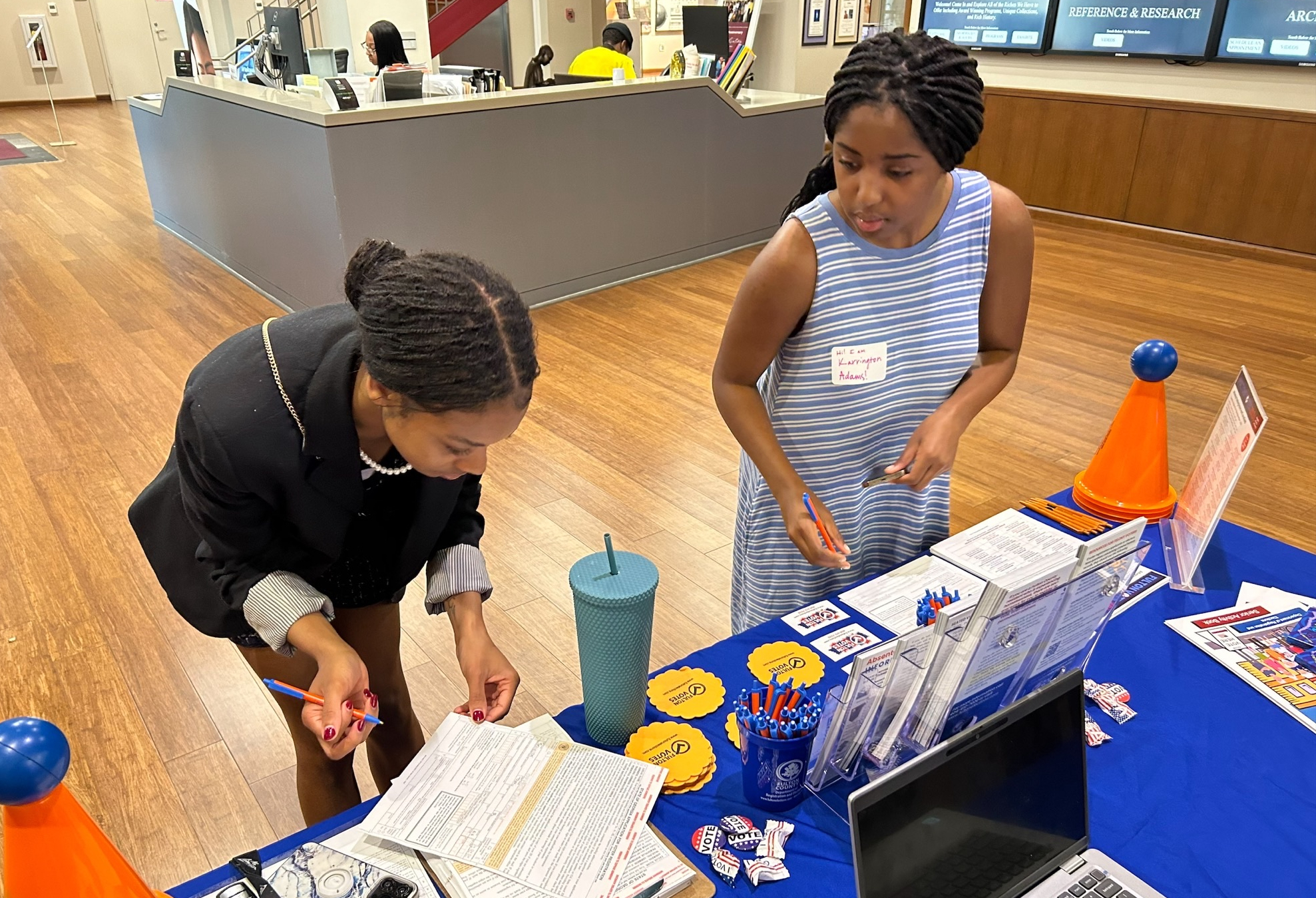
Spelman College students at Auburn Avenue Library participate in a UWCA of Atlanta event sponsored by Fulton County Votes. (Photo by LaShandra Little)
Power of paying attention
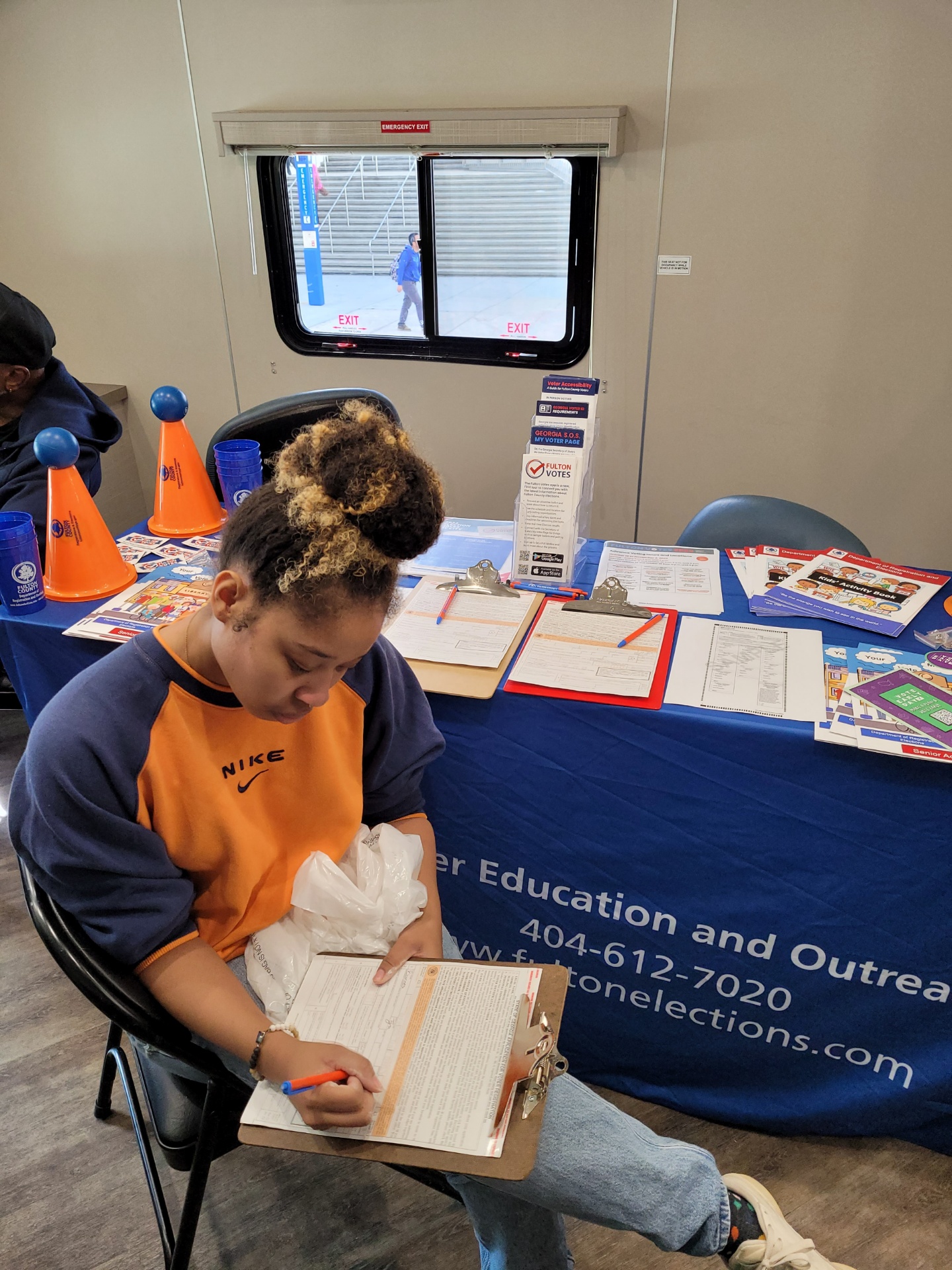
Fulton County Voter Education and Outreach Manager, LaShandra Little, heads the county’s effort to prepare voters to make an informed decision.
“Voter education is essential,” she stated in an email response to Canopy Atlanta. “We want to ensure that every citizen in Fulton County knows how to exercise their right to vote and instill confidence that the election will be fair and transparent. We allow all citizens to ask questions and gain knowledge about the election process…If citizens are equipped with the knowledge beforehand, it makes for a better overall experience for the voter to cast their ballot confidently.”
For some issues, like voting for judges or the Fulton County solicitor, most of them ran unopposed, so the community must be diligent in other ways.
Courtwatch is a way to sit in the courtroom and observe for yourself how judges are handling their cases. This can be done formally, by reaching out to Fulton County Courts and getting their permission, or informally, by visiting the courtroom, which is a public place, and observing for yourself how judges and members of the prosecutor’s office conduct themselves. The current televised YSL trial isn’t the only case that can be viewed from home. Most Fulton County judges can and should be linked on Youtube. Links for judges in State Court and Superior Court should be available to keep their proceedings public.
It’s also important to view public meetings, like the city council meetings, where you can view your local representative in action and see if they are addressing what concerns you the most. These meetings are broadcasted , and the department reports and community comments can be revealing enough for a voter to make a more informed decision. The Georgia Senate also has a list of committees you can reach out to with your concerns.
Just as powerful, but often overlooked, is sharing what you learn with friends and family and on social media, the way Shirley Harris does as a way of holding those in power accountable. Organizing behind causes and having a better understanding and devotion to the civic process, Pritchett advised.
“Start understanding what you’re voting for and how it affects your everyday life,” Pritchett summed it up. “If they took voting as seriously as they took fantasy football, we’d be in different shape.”
Knowledge is power
The phone doesn’t just come in handy for calls to your local government offices. For the tech savvy, there are some convenient ways to access information about the candidates.
Here is a sampling of apps and websites that can help you learn more about races at every level, including local ones:
Thanks to Ballotpedia, voters can, at the very least, get a general look at the candidates and ideas for new laws, also known as referendums to support or deny. Canopy Atlanta has a breakdown that tells you what these questions mean. The article also provides you with a look at how members of both the Georgia Senate and House of Representatives voted on the measures, which will give you some idea of who will benefit.
Specifically for Fulton voters, the Fulton Votes App will let you see early voting places, drop box locations, get help obtaining voter id and other voting gems. You can set notifications to get important updates, election results and even check your polling place wait time.
However, we did not see judges on the sample ballot. We also had to go to the Notice of Write-in Candidate section to see that Charles Rambo has qualified to be a write-in candidate for Fulton County Sheriff.
Vote Smart will allow you to conduct searches in two ways. One is by entering your address and locating candidates in your area. The other will allow you to enter the name of the candidate to get vital information about them.
Putting in your address will display races in your area, from national to local. This is also where you would find judges for the Georgia Supreme Court and council people on your local boards.
Want to know who is funding the Georgia Supreme Court judges? You can put in their name, click the funding tab and find out who contributed to their re-election campaign and how much. You can also put in your address and scroll down to the name of people running in your district and select candidates and public information about their positions and funding as well.
There is however limited information available through the site. Put in the name Keith Gammage, the Fulton County Solicitor or Fulton County Superior Court Judge Robert McBurney and you get no results. There was also limited information about Vice President Kamala Harris.
On Vote 411 you can register to vote, check the status of your registration and get a sample ballot. Putting in your address to get personalized voting information will let you see where to early vote, what races are currently active for your address, and specific races like school board and city council candidates. It also breaks down the absentee ballot process.
However, the site seemed to have limited resources for Georgia voters. Searching popular names like Fulton County District Attorney Fani Willis yielded no results. There were candidate debate videos and voting guides but none listed for Georgia.
Represent App, Represent Us, Votable, Relevote and Congress Vote Tracker show bills in their entirety, list members of both houses and provide their contact information.
Editor: Stephanie Toone
Fact Checker: Julianna Bragg
Canopy Atlanta Reader: Kamille Whittaker and Mariann Martin
I hope this story leaves you inspired by the power of community-focused journalism. Here at Canopy Atlanta, we're driven by a unique mission: to uncover and amplify the voices and stories that often go unheard in traditional newsrooms.
Our nonprofit model allows us to prioritize meaningful journalism that truly serves the needs of our community. We're dedicated to providing you with insightful, thought-provoking stories that shed light on the issues and stories that matter most to neighborhoods across Atlanta.
By supporting our newsroom, you're not just supporting journalism – you're investing in Atlanta. Small and large donations enable us to continue our vital work of uncovering stories in underrepresented communities, stories that deserve to be told and heard.
From Bankhead to South DeKalb to Norcross, I believe in the power of our journalism and the impact it can have on our city.
If you can, please consider supporting us with a small gift today. Your support is vital to continuing our mission.
Floyd Hall, co-founder