On a windy Saturday morning, young people from across the country gathered in a plaza on the Morehouse College campus downtown. Equipped with signs, song sheets, and bottles of water, demonstrators readied themselves to march from the Martin Luther King Jr. International Chapel and defy what one protestor called an “immoral” law.
They were gathered to protest Senate Bill 202, which was adopted by the Georgia State Assembly in 2021 and makes handing out food or water to voters within 150 feet of a polling site punishable by a $1,000 fine and up to 12 months in jail.

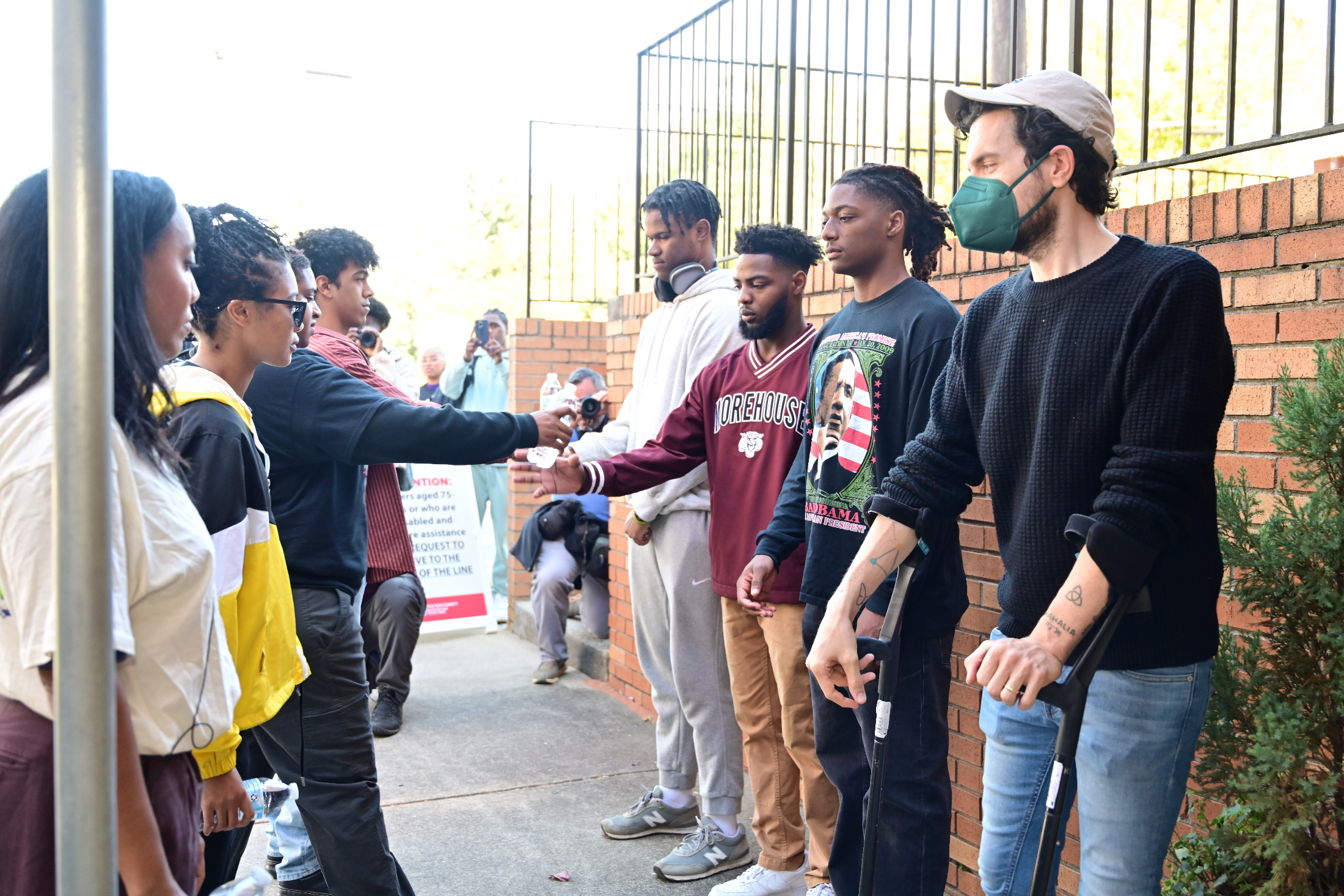
Nicole Carty, executive director of Get Free, a youth-led movement focusing on equality, says the bill was crafted to target urban areas with long wait times and “significantly more black and brown voters,” but it also affects the disabled and the elderly. The Get Free demonstrators ensured every voter received a bottle of water on Saturday.
“We’ve got people from New Hampshire, New York, Florida, and Georgia,” says Carty. “While SB 202 is in Georgia, [voter] suppression is happening all over the country.”
“We must continue to violate any law that stands in the way of God’s law.”
Rev. Matthew V. Johnson Jr., from Faith in Public Life Action, decried the law as immoral.
“Imagine: It’s 2020, you’re an election official. You see people standing in 11-hour lines to vote being handed food and water. And the problem you see is the food and water, not the 11-hour lines,” he says. “We must continue to violate any law that stands in the way of God’s law.”
Nearly 70 Gen-Zers and millennials—queer advocates, reverends, disability rights organizers, and Civil Rights advocates—shuffled about the plaza. “After today, we’re gonna talk about what you did,” said Gerald Griggs, an attorney and the president of the Georgia state conference of the NAACP. “Because what you did is important for your grandparents and your grandbabies.”

Get Free demonstrators hand out water to early voters at Flipper AME Church on Oct. 19, 2024.
Get Free executive director Carty is following in the footsteps of her grandfather, an Episcopalian minister who participated in the Civil Rights movement. “These laws are modern-day versions of Jim Crow laws my family fought against,” she says. “It’s frustrating. It’s exhausting.”
Her grandfather, the late Rev. Denzil A. Carty, fought for voting equality years before her birth. In 1963, he was a part of the 58-person Minnesota contingent to attend the groundbreaking March on Washington for Jobs and Freedom in Washington, D.C. The following year, Rev. Denzil A. Carty led a “prayer intercession” at the Minnesota state capitol building to support the Civil Rights Act of 1964.
More than 60 years later, bystanders participating in Clark Atlanta University’s homecoming celebration—also happening on this particular morning—lent their voices, dance, and energy to the marchers: Children and cheerleaders clapped along to the songs and called out their support as the crowd made its way to Flipper Temple African Methodist Episcopal Church, a polling site within a precinct with historically low voter turnout.
“We’re riled up, we’re ready, and we won’t go back,” Carty told the group.
The activists approached the polling place with water bottles in hand. As voters lined up at the front doors that day, Johnson read an excerpt from the book of Matthew: “For I was hungry, and you gave me something to eat. I was thirsty and you gave me something to drink. I was a stranger and you invited me in.”
Get Free will continue its mobilization of young voters by hosting a Zoom meeting Wednesday to discuss “dynamic action for voters’ freedom” and a petition demanding Governor Brian Kemp revoke SB 202.
Editor: Stephanie Toone
Fact Checker: Julianna Bragg
Canopy Atlanta Reader: Heather Buckner
I hope this story leaves you inspired by the power of community-focused journalism. Here at Canopy Atlanta, we're driven by a unique mission: to uncover and amplify the voices and stories that often go unheard in traditional newsrooms.
Our nonprofit model allows us to prioritize meaningful journalism that truly serves the needs of our community. We're dedicated to providing you with insightful, thought-provoking stories that shed light on the issues and stories that matter most to neighborhoods across Atlanta.
By supporting our newsroom, you're not just supporting journalism – you're investing in Atlanta. Small and large donations enable us to continue our vital work of uncovering stories in underrepresented communities, stories that deserve to be told and heard.
From Bankhead to South DeKalb to Norcross, I believe in the power of our journalism and the impact it can have on our city.
If you can, please consider supporting us with a small gift today. Your support is vital to continuing our mission.
Floyd Hall, co-founder