Canopy Atlanta asked over 140 Tri-Cities community members about the journalism they needed. This story emerged from that feedback.
Some residents were happy to remember musical artists who have famously come from or attended school in the area. ("Lots of musicians are from Tri-Cities: Ludacris, OutKast. There is a rich heritage here," one College Park resident said.)
Others spoke about the artists who remain in the area and can still use support, so that the overall local scene could be "thriving," as one community member said.
Canopy Atlanta also trains and pays community members, our Fellows, to learn reporting skills to better serve their community. Eboné Smiley, a reporter of this story, is a Canopy Atlanta Fellow.

Thanks to its visual and performing arts magnet program, which offers classes in everything from modern dance to television production, Tri-Cities High School is famous for producing some of Atlanta’s brightest stars in entertainment. A few names that come to mind are Emmy award winner Kenan Thompson, Tony Award winner Joaquina Kalukango, Kennedy Center composer-in-residence Carlos Simon, and members of OutKast, Jagged Edge, and Xscape.
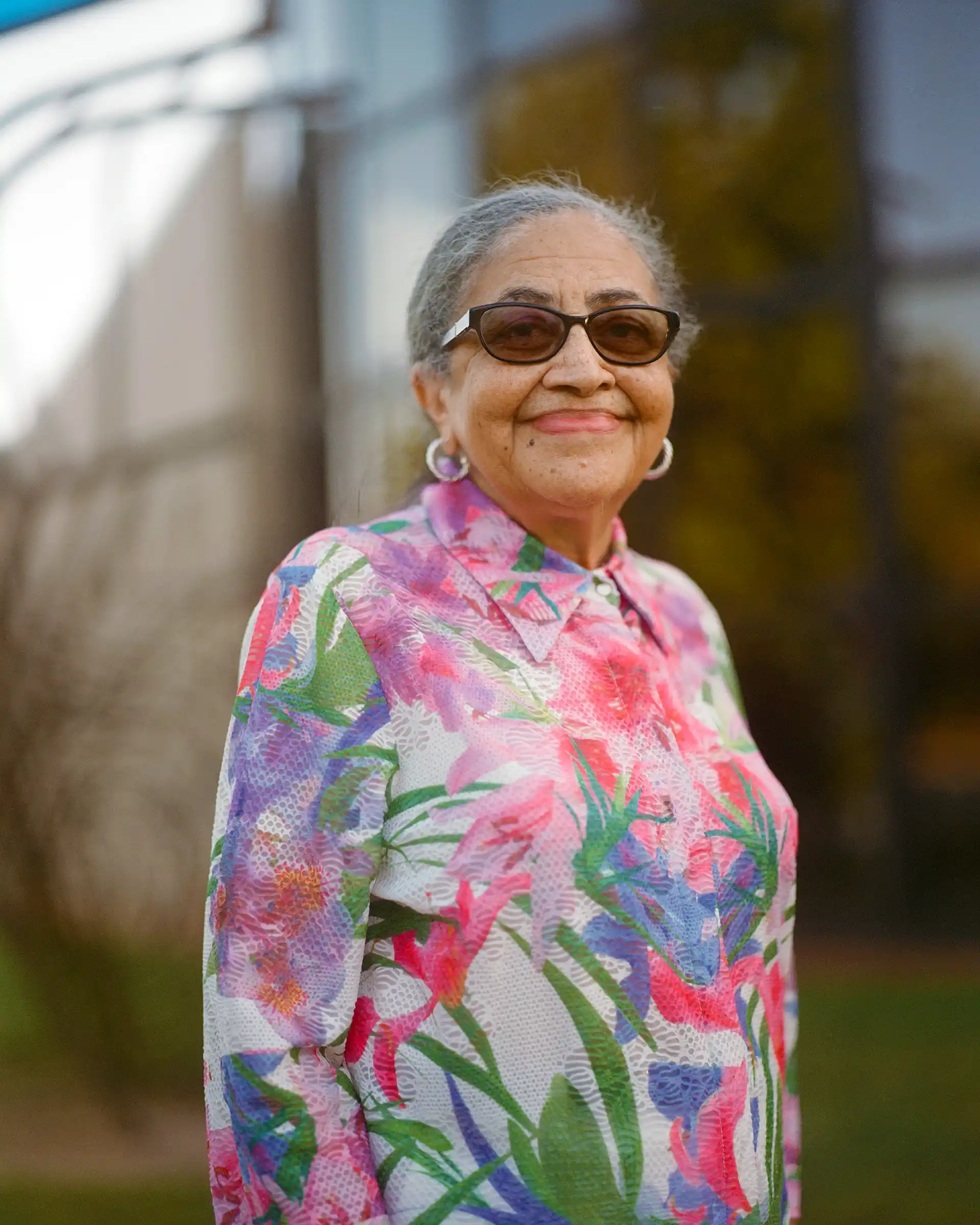
The high school’s theater is named after Viola Turner, who started directing the magnet program after its pilot phase in 1991, and continued until her retirement in the mid-2000s.
“You could walk down the halls and hear kids singing. In the cafeteria, they would be rapping,” she says, standing in front of the theater named after her.

Turner says that during her 15-plus year tenure, it was “a God-given mission” to bring out students’ full potential—and for everyone else to believe in them, in order to build their self-esteem.
“People said, ‘Oh, you know these kids can’t do that. They aren’t going to be able to go on in the arts. They’re wasting their time,’” she says. “Even when Kenan was at Nickelodeon, I remember some teachers didn’t want to send his homework to Nickelodeon because they had education on location. I was saying to the teachers, ‘How can you deny a young Black student who was trying to make it? How can you not send his homework?’”
Turner came to Tri-Cities as an English and drama teacher. One of the first stages she set for students was in the school’s cafeteria. “We had to go all the way to College Park Auditorium when we were going to do something—and we did excerpts from shows because College Park Auditorium was not equipped for a musical,” she says. (It wasn’t until her namesake theater was built that students could at last perform full musicals, the first being The Wiz.)
For the program’s after school classes three times a week, Turner brought in band instructors and vocal coach Donna Turner from Capitol City Opera because she knew students “needed to be exposed to all forms of music.”
“I don’t know of any other high school who could do a full opera,” she says. (That opera was Treemonisha.)
In an early search for another drama teacher, one of her students, Kandi Burress of Xscape and Real Housewives of Atlanta, recommended Freddie Hendricks, who was already training her. (Hendricks went on to become Tri-Cities’ drama director, recruiting students like Kenan Thompson, his brother Kerwin, Kalukongo, and Broadway actor Jahi Kearse.)
“A few weeks ago, I saw a {former} student at Red Lobster. She said, Ms. Turner, you’re the reason I was able to finish at Tri-Cities.”
Turner brought in such personnel because she figured that parents in the northern parts of Fulton County “can afford to give their kids private lessons,” compared to where Tri-Cities High School is located. To qualify for the program, however, students must audition and then maintain a B average. Turner even created mottos for different years of the program: “We started out ‘Striving for Excellence.’ Then it was ‘Exceeding Expectations.’”
“I stress the academics and the arts,” she says. “So if you were going to be in this program, you had to maintain—they said a 75 overall, but I said that’s not enough.”
Turner says the results speak for themselves. Students haven’t just become performers—they’ve become top designers, doctors, and teachers themselves. “I picked up Atlanta magazine last year, and one of our students, who’s a dermatologist, was listed as one of the top doctors,” she says. “I was like, Oh my gosh, is that Jessica Mercer?”
Even though Turner retired nearly 20 years ago, parents of Tri-Cities’ current drama students have her number, just in case. She also keeps up with how students fare long after they graduate. On Facebook, she’ll see comments about how past students would never have come to Tri-Cities without the magnet program.
“A few weeks ago, I saw a [former] student at Red Lobster,” she says. “She said, ‘Ms. Turner, you’re the reason I was able to finish at Tri-Cities.’ I remembered her distinctly because she had such low self esteem, and I really made it a point to work closely with her and say, ‘You can be anything you want to be. You just have to work. It’s not going to be given to you on a silver platter.’”
Turner also remains in close touch with the school’s alumni association, which is how she learned that the magnet program she helped build may not be able to accommodate as many students as when she was director (at one point, up to 400).
A few months ago, Turner heard that the Fulton County school board voted to end bussing for the arts magnet program. That’s why on Sept. 17, 2024, she and Hendricks tracked down and attended an informational meeting held in the Tri-Cities High School media center to find out more.
“How could you make a decision that would impact Tri-Cities and other schools without informing and not there being some communication with the community and parents?” Turner says. “They talked about these changes that they were making in February—voted on in February. My question was, ‘Why are we just finding out about this, and why are we finding out after the fact? You’ve already voted.’”
“My concern is that it’s going to impact our Black and brown children most of all.”
An anonymous source with ties to the school confirmed that this meeting took place and spoke to Canopy Atlanta.
According to Turner, a superintendent told her that Fulton County Schools cannot find enough bus drivers to accommodate all its magnet programs. She was dissatisfied with that answer. Without provided transportation, she figures that the arts magnet program could cease to exist in the next four to five years. She hopes to chat further with that same superintendent, and Tri-Cities’ current principal, about why something needs to be done.
“My concern is that it’s going to impact our Black and brown children most of all,” she says. “They’re saying we aren’t going to have buses for the other magnet programs as well. I don’t know about the other magnet programs, but I know that here’s a program where the students have gone out into the world and become very successful—in all areas.”
Editor: Christina Lee and Kamille D. Whittaker
Fact Checker: Ashley Trawick
Canopy Atlanta Reader: Mariann Martin
I hope this story leaves you inspired by the power of community-focused journalism. Here at Canopy Atlanta, we're driven by a unique mission: to uncover and amplify the voices and stories that often go unheard in traditional newsrooms.
Our nonprofit model allows us to prioritize meaningful journalism that truly serves the needs of our community. We're dedicated to providing you with insightful, thought-provoking stories that shed light on the issues and stories that matter most to neighborhoods across Atlanta.
By supporting our newsroom, you're not just supporting journalism – you're investing in Atlanta. Small and large donations enable us to continue our vital work of uncovering stories in underrepresented communities, stories that deserve to be told and heard.
From Bankhead to South DeKalb to Norcross, I believe in the power of our journalism and the impact it can have on our city.
If you can, please consider supporting us with a small gift today. Your support is vital to continuing our mission.
Floyd Hall, co-founder