On the day Bridgette Simpson was released from the Department of Corrections, officials told her she would never be able to vote again.
“They want you to feel stuck,” Simpson, a justice-impacted person recalls. “They try to put stuff in your head. That they’ll see you again, that you’ll be back. But they don’t really tell you once you complete your sentence ‘you’ll be able to vote again.’”
Over 450,000 Georgians with previous felony convictions are eligible to vote, according to a recent AP story, but many are unaware of this fact. Organizations like Barred Business, founded by Simpson, were established to restore some of those benefits and provide education for those adversely affected by the justice system. Despite those efforts, some people choose not to pursue their right to vote, even if they are restored.
When Canopy Atlanta’s community engagement team spoke with voters and nonvoters over the summer, nearly a quarter of the people said they felt like their vote didn’t matter. But believing that one can’t vote when they can creates a different kind of barrier with some states actively making sure justice-impacted people know their voting rights, some states making it very difficult, and some choosing to not allow those with felonies to vote at all. Those who work with and are justice-impacted Atlantans discuss the impact of the campaign to limit or misinform those formerly convicted about their voting rights.
Simpson says most of the people she encounters are learning they are eligible to vote for the first time, and the system is built to keep it that way.
“People are glad to be a part of the process. They want to participate in their communities,” she says. “I think there’s a lot of time, effort, and resources spent making folks believe that they can’t vote.”
While I was incarcerated and on my way out, it was constantly beat into me, ‘Oh, you’ll never be able to vote again.’”
Simpson began her work as the co-founder/co-director of Barred Business to ensure that those with prior convictions would have awareness about these issues. Earlier this month, Barred Business received the policy innovation award at the Center for Civic Innovation’s “Good Trouble” Honors, which annually recognizes nonprofits creating “necessary good trouble” around metro Atlanta.
“We educate people about their rights. We physically register people to vote. We help people get to their polling locations on the day of. We also help mobilize people to the election board and we advocate around making sure all people get the right to vote.”
The mental toll of losing rights
The National Institute of Justice states there are 44,000 documented rights a person with a felony conviction loses. There are things their families are not allowed to do for them as well. For instance, those with prior felony convictions cannot live in public housing with their families, serve as caretakers to their parents, or adopt children, Simpson pointed out from the report. They are also ineligible for certain types of health insurance.
“[The insurance companies] will not fund you because they feel like you are high risk,” Simpson says, “Justice-impacted people make up 93 percent of the homeless population in the city of Atlanta. I know the area where our office is nested, in Mechanicsville, has the highest rate of incarceration, at 94 percent and 93 percent for recidivism.”
While the overall impact of politics is difficult to measure, the strain on mental health is well-documented. A February 2024 Pew Research Center poll found that 65 percent of U.S. adults always or often felt exhausted by politics and 55 percent always or often felt angry. Atlanta therapist, Latrice Lewis of Wellspring Counseling, Coaching and Transitions, has noticed an uptick in distress in her patients. “There’s an increase for a lot of people in general depression and anxiety,” Lewis said.
Project 2025 in particular has opened up a new avenue of anxiety, according to Lewis. With proposals that roll back the rights and protections of marginalized communities, Lewis says that she is hearing concerns about safety she hasn’t heard before. “Are they safe out in their community, especially from people who strongly support a candidate’s views? Am I safe if a candidate is in office? Am I safe if these people who feel like they have a platform or voice now no longer have to hide their anger or their hate? I see that issue a lot.”
The impact of this fear has caused some to “lose connection to self-care.” Lewis says she recommends that her patients “limit their exposure to it, while not being ignorant.”
Clinician and trauma specialist, Imani Evans, has experienced both sides of this issue. After her felony conviction, Evans was not sure whether she could or couldn’t be a part of the civic process.
“It was humiliating,” she recalls.
Experiencing that humiliation gives her a unique perspective on what her justice-impacted clients are experiencing.
“The inability to participate in the voting process can have a profound and traumatic effect on justice-impacted people. It’s a significant loss of a political voice, for both the individual and the community.”
According to an October report by The Sentencing Project, an organization that advocates for reducing imprisonment, almost 250,000 Georgians cannot vote because of a felony conviction, which is more than 3 percent of the voting-eligible population. Nationwide, that number is 4 million.
If you have a community where a large percentage, even if it’s 10 percent, if they’re unable to participate in civic life, then they are subsequently in a situation where they are feeling powerless and disenfranchised, as both an individual and a community, because things are happening to you, but not through you. You cannot participate and contribute in the decisions that affect you.
The resulting feelings of unworthiness and anxiety can create long-term, critical mental health challenges for the justice-impacted, according to Evans. There are feelings of guilt and shame, considering that for Black and brown people they’ve had “people who died” so they can vote.
“To have that taken away, for a decision that may have happened many years prior to that moment, seems like you’re never escaping the decision that you made.”
Confusion and misinformation about whether one has the right to vote feeds into the lack of political activity in certain areas, contributing to the lowest voter turnouts in Georgia.
“It’s a lack of trust. Why would you trust a system that has harmed you? If you disenfranchise a person enough, then you can stop suppressing them because at some point, they start internalizing that suppression and they will suppress and oppress themselves,” Evans explains.
Listen to excerpts from Pristine Parr's interview with Bridgette Simpson
Listen to excerpts from Pristine Parr's interview with Imani Evans

Working around the limitations
As she began work with Barred Business, Simpson knew from the beginning she would not give up on the political process, even if she was prohibited from voting.
“I was like, okay, well, if I’m not going to be able to vote, I can get my mom to vote for me. I can get my family members to vote for me…I can’t vote but you can, you can be my voice…You just can’t completely push me out of the process. I can influence.”
And that’s what she did. When she returned from incarceration, she worked on a campaign prior to her voting rights being restored. She canvassed in neighborhoods throughout Atlanta.
When Simpson learned that she could vote once she completed her probation, she was shocked. “Once I was off paper and I could vote, I had a whole party. I had a party behind me registering to vote. And it was amazing.”
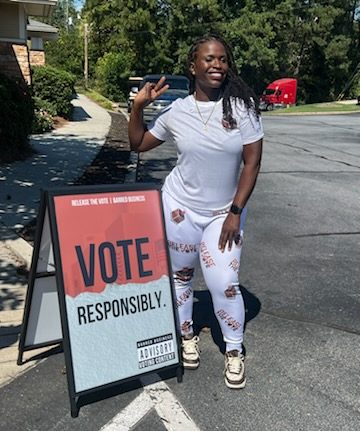
Simpson and her team at Barred Business continue to encounter attempts to keep people in the dark about their right to vote. Through programs like “Release the Vote,” Barred Business is campaigning to build “real power” by registering 5,000 justice-impacted people to vote, which will mobilize and activate people who have gone through the justice system.
“People invest in our demographic not knowing that [some with felony convictions can vote]. That’s a part of our potential power. Even the percentage of us that can vote, who are eligible right now, those numbers will be ridiculous, right? If even a fraction of us were to wake up.”
DID YOU KNOW?
Georgians can register to vote even if in custody, according to the U.S. Vote Foundation. If you’re serving a sentence and not convicted of a felony, you can vote using an absentee ballot (it must be requested). Individuals who are convicted of a felony can vote once they have completed their sentence, including probation and parole. Once done with that process, they must also re-register to vote if they were previously registered.
SHARE YOUR STORY
Barred Business hosts #TheRealTruth, a weekly Instagram Live show that invites those who are justice-impacted to share their stories. Sign up here to be featured on the show and learn more about programs and campaigns at Barred Business.
Editors: Stephanie Toone
Canopy Atlanta Readers: Kamille Whittaker and Mariann Martin
I hope this story leaves you inspired by the power of community-focused journalism. Here at Canopy Atlanta, we're driven by a unique mission: to uncover and amplify the voices and stories that often go unheard in traditional newsrooms.
Our nonprofit model allows us to prioritize meaningful journalism that truly serves the needs of our community. We're dedicated to providing you with insightful, thought-provoking stories that shed light on the issues and stories that matter most to neighborhoods across Atlanta.
By supporting our newsroom, you're not just supporting journalism – you're investing in Atlanta. Small and large donations enable us to continue our vital work of uncovering stories in underrepresented communities, stories that deserve to be told and heard.
From Bankhead to South DeKalb to Norcross, I believe in the power of our journalism and the impact it can have on our city.
If you can, please consider supporting us with a small gift today. Your support is vital to continuing our mission.
Floyd Hall, co-founder