Canopy Atlanta asked more than 120 Tri-Cities community members about the journalism they needed. Many of them spoke about the rich music history of the area. This story emerged from that feedback.
Canopy Atlanta also trains and pays community members, our Fellows, to learn reporting skills to better serve their community. Immanuel Laidlaw, the reporter on this story, is a Canopy Atlanta Fellow.

From the time I woke up, I knew it was going to be a good but long day in the field. With no time to complain, we gave thanks and got out to get something.
It was a hot Atlanta morning—you know the sun ain’t no joke. I was assisting award-winning photojournalist Rita Harper, reporting the stories of not just several of her fellow alumni from Tri-Cities High School, but also the most important music legacy of the past 30 years in this region. We were doing it on the intersection of Headland and Delowe in East Point, right by the beauty supply store where the late Rico Wade worked, and had André 3000 and Big Boi audition to be part of the Dungeon Family hip-hop collective.

The interviews and photoshoot felt like a class reunion—everyone was happy to be there, excited to have their perspective on the Dungeon Family’s legacy immortalized in ink. These folks weren’t just fans of the music; they had shared many of the same pathways, experiences, and connections to the Tri-Cities area as the Dungeon Family, feeling aligned with the grind and resonating with the rhyme, as the music guided them towards success, passion, and positivity.
We sat with these community members to ask them: the Dungeon Family has undoubtedly impacted Atlanta, hip-hop, and the world—hundreds of songs released, millions of records sold. But what about Tri-Cities? What about East Point?
I’ll let these community folks talk they talk because they damn sure walk it.
Interviews have been condensed for length and clarity.
Brian “B-High” Hightower
As a Benjamin E. Mays High School alum alongside members of the Dungeon Family, the impact that the collective had on journalist Brian “B-High” Hightower was profound. While building a platform with more than 300,000 YouTube subscribers, Hightower credits a large part of his success to his interviews with Dungeon Family members.
“When will we see another group out of Southwest Atlanta, the Westside, or Atlanta in general, that can represent both the streets and the suites, moving between the two and making an impact on the culture that changes the trajectory of the city for the next 50 years?”
“Southernplayalisticadillacmuzik was the first CD I ever bought. I went down to Greenbriar Mall, to Peppermint, and that was the first CD I ever got—and I ain’t been the same ever since.”
For award-winning media personality and distinguished Clark Atlanta University professor Brian Hightower, the Dungeon Family’s legacy saved a whole generation. “That music alone. We didn’t drill. We didn’t gang bang. We were playas. We were trying to get up, get out, and get something.”
But it didn’t stop there. This music didn’t just save lives; it moved our culture forward, paving a path for those who didn’t know which way to go, he says. “Rico Wade put that second Dungeon in the middle of Cascade, man. It was still in the hood. It was an upper-scale part of the hood, but it was dead smack in the middle of the doggone hood. That impact when you see them posted at the grocery stores, you see them posted at the club, you see them posted at the mall, you see folks all over the place—man.”

“So when you saw OutKast, Goodie Mob, the Dungeon Family, Backbone, Witchdoctor, Cool Breeze, and all of them go national with positive vibes that moved the culture forward, it let me know that when it was my time to hit the entertainment world and the stage, I could do it positively and shed light on Atlanta, represent where I’m from, and know I had the right to do so because my forefathers had already kicked in the door for me.”
Seeing people he knew, folks who graduated before him, go out and do what fellow Benjamin Mays alumni like Goodie Mob’s Khujo, Gipp, and T-Mo did, was priceless. The belief that one can only be as good as one’s point of reference is something B-High took to heart, crediting a large part of his success to his interviews with Dungeon Family members.
“I saw Big Boi at Bruno’s when I was a kid, but I didn’t speak to him; I just remember saying, That’s Big Boi over there at Bruno’s! I saw Goodie Mob at the club, and it was all love. Backbone might’ve been the first person from the Dungeon I ever interviewed. And then Gipp came through and helped launch my career because his interviews were some of the biggest I’ve ever done.”
``They represented for the people that didn't know that they could be great, and they showed us that we could be great.``
— Brian “B-High” Hightower
But how did he get the interview? Hightower shared that after getting let go from the radio station for the first time (another story for another day), a brief phone call to fellow ATLien, rapper, and businessman Scottie ATL landed him the interview with Gipp and blossomed a brotherhood that has by way of information sharing empowered so many like-minded individuals.
“He’s my OG, man. You can call him, ask him questions, and he’ll give you the truth—his real opinion on what’s going on. Gipp’s that person who’s sowed into so many people’s lives, not just through the music, but by genuinely helping. He’ll give you that co-sign, show up for your interview, show up to the studio session, and be there like you need someone to be there for you. You see what I’m saying?
“In Atlanta, every member of the Dungeon Family is like a walking time capsule—both legend and icon. We have living legends in the city who, when you see them, you know they put it down for the town like nobody else, especially when it comes to entertainment. But Khujo, T-Mo, CeeLo— those guys are really community activists and pillars in the community at the same time. You’ve got to love them. And if you don’t respect them, then you probably don’t have any respect for yourself.”
D’Asia Skyers
East Point native and Tri-Cities High School alum D’Asia Skyers says that the Dungeon Family provided the soundtrack to her life. She means that “literally and figuratively,” as her father just so happened to have been friends with Rico Wade and performed with the collective.
“I did not like being in Stone Mountain. I made a few friends, but they can do what they do. I don’t really mess with the Mountain like that. But it definitely just reminded me, like, no, I’m from East Point. I don’t remember a time when I wasn’t proud to say that.”
For D’Asia, who may be considered a Dungeon Family member herself, the story is more personal. Her father often made music with various members of the family when she was just an adolescent, and she recalls many weekends and summers immersed in the process—a spirit she still embraces today.
“I met most of them, if not all of them. I have very fond memories of meeting some of them. . . summers when they were throwing parties, but the-kids-had-to-be-inside type shit. It was definitely a vibe growing up. The music that has come from that particular conglomerate really paved the way for how I consume a lot of things now.”

But while many adults raised on OutKast’s music might claim Aquemini or ATLiens as their favorite album, she feels differently.
“I’m 34, so a lot of people my age are going to drop Aquemini or those older projects because they know those are foundational, right?”
But for D’Asia, it’s no question—her favorite body of work from the group is Stankonia, one of the best-selling albums of the 2000s that pushed them into an upper echelon. At that time, fourth-grade D’Asia had just been relocated to Stone Mountain, and she was miserable.
“I spent two years away from East Point, going to school in Stone Mountain for fourth and fifth grade. If you’ve ever switched schools in elementary, it’s a culture shock. You’re going from knowing people since before you could read, to having to create and cultivate new friendships. It was hard for me, and it just so happened to be the year you won’t forget, when Stankonia dropped.
{Stankonia} definitely just reminded me, like, no, I’m from East Point. I don’t remember a time when I wasn’t proud to say that.
— D’Asia Skyers
“When I tell you that me and my sister knew every lyric of every song on that album, frontwards and backwards, that’s all we let my mama play in the car. (She was supportive of it, of course; she came up right along that.) That’s forever gonna hold a special place in my heart, that body of work. It was obviously one of their biggest albums that pushed them into mainstream music—but it was so reminiscent of home.
Upon returning to East Point, D’Asia went to Tri-Cities High School, recalling it as the best time of her life. Growing up in an environment that instilled so much confidence was pivotal. Whether your desire was stardom, entrepreneurship, education, or employment, she says you were charged to pursue it in a way reminiscent of those who came before you. If you ever forgot, there were constant reminders in the school and community of who you were and the reputation you had to uphold in whatever you did.
“You can’t put people in a box when they’ve been instilled with such culture and confidence and bravery.”
P.S.
“I would like to go on record to give a shoutout to Rico Wade’s family, as they’re dealing with his loss and sudden passing. Rico was definitely a dope individual. I have very fond memories of the bond he and my dad were able to create over the years . . . One of my dad’s birthdays, say two years ago, [he] just happened to get everybody together, and Rico was there.
“When you meet people that you knew when you were little and they’re able to see you in the lens of like, ‘Wow, you’re grown now,’ it’s always very special. It’s never nothing weird, it’s always just respect. ‘I remember when y’all were that young. Y’all grew up to be so smart. Y’all doing your thing. I’m proud of y’all.’ Those were always the words that he [Rico] had for me and my sister.
“That’s always a special thing. Shout out to them.”
Cedric Smith
Cedric Smith is a visual artist who was born and raised in East Point, and attended Paul D. West Middle School and Tri-Cities High School.
“Specifically with rap, New York always getting put on. . . . Dungeon Family gave some weight to saying you’re from East Point. I remember going to college, and it was just like, Oh, I’m from East Point. I went to the same school as OutKast. And Dungeon Family was down the street; I grew up down the street from Headland and Delowe. Everybody like, Oh, okay! . . . You hear the story about the basement and what’s called the Dungeon. It made everybody feel like, You know what? What I have is enough. The most important thing I needed was community.”
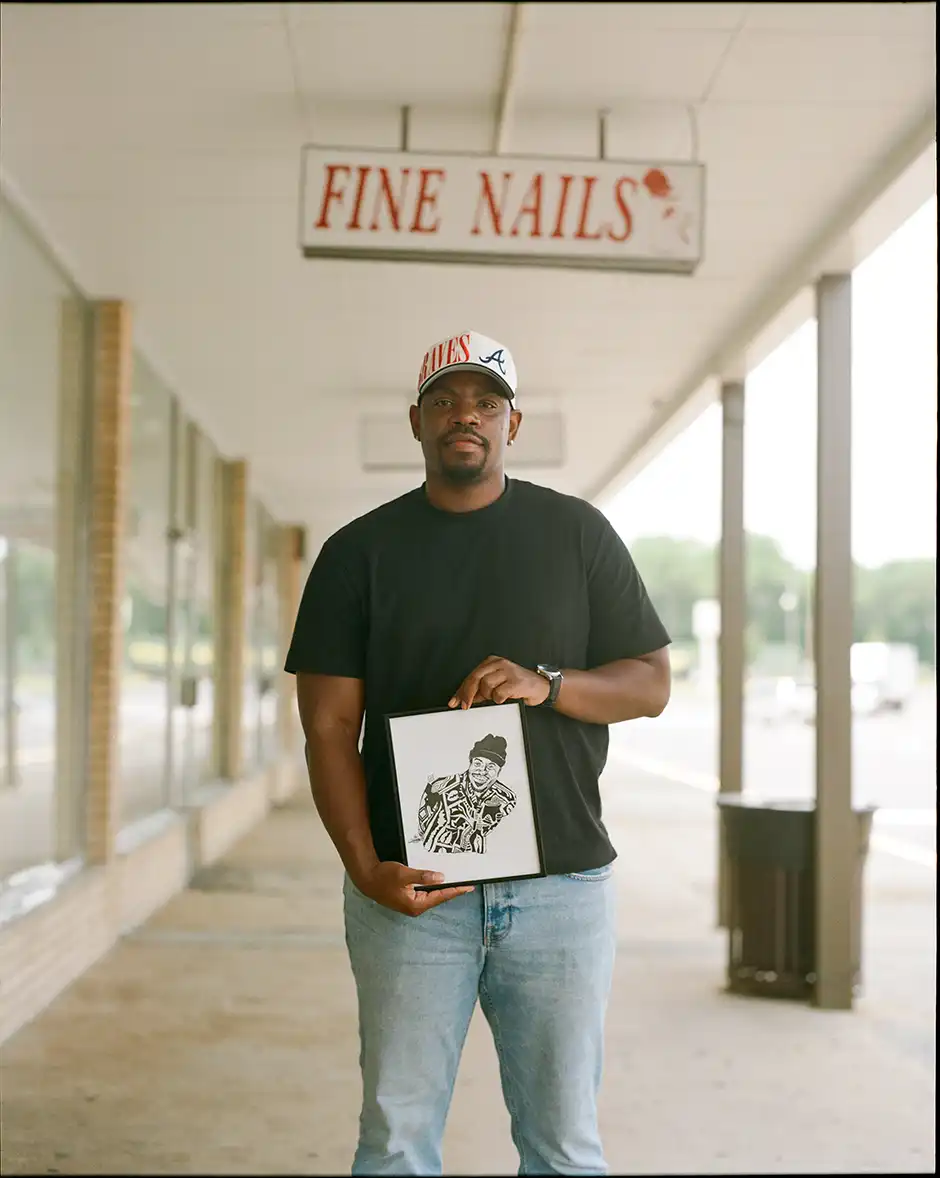
“I used to go to my cousin’s house, my favorite cousin, and he used to be a big music head…And he was just like, ‘Man, you gotta listen to these folk. Man, how you from East Point and you don’t know about these folk?’
“It changed my life. I was like, Bro, what is this? This ain’t even—is this rap? It’s like some Tribe Called Quest/R&B/90’s vibe type of stuff or whatever. And then listening to Big Rube, do like this poetry, but I’m talking, but I’m rapping kind of thing going on at the same time.
“Being in East Point, it’s like, Is it East Point? Is it Atlanta? Is it this or whatever like that? Dungeon Family kinda gave some weight to saying you’re from East Point, you know what I mean?”
Many Tri-City alumni, such as ‘God’s favorite creative’ Cedric Smith, who matriculated through the same school as Dungeon Family members like André 3000, Big Boi, and Big Gipp (research the rest), feel not only a sense of pride but also a motivation to create their own pathways.
“Yeah, I got a picture with CeeLo. Listen, man, it was like, full circle moment. It was just in the midst of the whole COVID situation or whatever. We had the mask, so the picture ain’t really worth a damn, ‘cause we both got our masks on.
“I know it’s CeeLo. Everybody probably know it’s CeeLo. ‘Cause it was like, we walked down the same hallway. I found out they used to work at the airport too. I work at the airport.
“And it’s a household name. It’s an East Point dude who’s a household name.
“No matter what you tell yourself, no matter what life is lifeing, we cut from the same cloth, we built with the same material.”
Jeremy Bowers
Jeremy Bowers is a hip-hop artist who raps as Cousin Kuwgi, and has ties to East Point.
“So I did not graduate high school with a diploma. So when CeeLo said, “I don’t recall ever graduating at all,” that resonated with me. Even when Dre said, “Never smelled aroma of diploma, but I write the deepest rhymes, so let me take y’all away.” That song alone, I was just like, Damn. Ain’t got no shame.”
For Cousin Kuwgi, the Dungeon Family has always represented sonder and individuality.
“I used to go to my grandmother’s house. I used to walk from Paul D. West to my grandma’s house. And I remember every day Rap City in the basement. Yeah, I think that was the very first ‘Rosa Parks.’ That music video was the very first time I experienced anything of the Dungeon Family.
“It was back in ‘90. I was probably like eight years old, glued to the TV, had no idea of anything.
“[While I briefly attended Tri-Cities High School], I was just telling a good friend the other day, that around lunchtime every day, me and my homeboys would go outside and freestyle. That was our source of entertainment. We’d skip lunch and just go outside, have your bars ready.
“If your bars were trash, you may not come back the next day, for real. Like, I’m gonna be honest with you. Go be on the injured list, ‘cause you’re going to get clowned.”

Ebony Blanding and Brandon “Puncho” Williams
Ebony Blanding is a writer, director, and story-teller from East Point who graduated from Tri-Cities High School. Her work has been screened at various universities and film festivals around the world. Brandon “Puncho” Williams is an entrepreneur and business owner from Southwest Atlanta.
“That was one of the first musical groups that made me feel very proud to be from this land, and to really rep Georgia as a whole.”
Ebony Blanding, one of Atlanta’s favorite daughters, remembers being introduced to the Dungeon during rides home from school with her older cousins.
“When I think about where I first heard it, it was inescapable. It’s through my cousins. My cousin Gary, he’s from Alabama. My cousin Papoose, he’s from Atlanta. When they would pick me up from school, when I would be around them, that’s all I would hear. They would stop records and teach me about what each verse was, and what they was talking about, and what I need to take from it. ‘You hear this shit?’…That was one of the first musical groups and members that made me feel very proud to be from this land.”

As an forward thinking adult, today she attributes her connection to the Dungeon Family to both Georgia’s red clay and the intergalactic cosmos.
This ethereal deep-rooted connection has made her comfortable expressing herself in any era, resulting in her shaking up the filmmaking industry in Atlanta.
“Like when it comes to filmmaking and why I always lean into saying [the South got something to say], and this was before everybody was really saying it like that.”
“I think it is such an identifier and kind of like saying I’m very capable of leading my own storytelling, and as filmmakers who are based in Georgia, in the South quite often, folks still think that you have to take leadership from Hollywood or New York, if you will.
“To me, it just allowed me to lean into the power that I know we all have with our storytelling here. I’m so grateful for that because it’s an easy way also to tell people, Let me talk my shit, let me pop my shit, and I don’t need no support other than munyun.”
That was one of the first musical groups that made me feel very proud to be from this land, and to really rep Georgia as a whole.
— Ebony Blanding
For filmmaker and business owner, Brandon “Puncho” Williams, as native of East Point from an early age, he recalls the Dungeon Family serving as a quintessential North Star. Having access to local change makers informed Puncho on the “right” way to exist.
Like many youths of that time, when Puncho heard Southernplayalisticadillacmuzik in 1994, everything changed. What once seemed like a dream deferred was being created right in his own community, East Point.
“When Southernplayalisticadillacmuzik dropped, and that video came out, we understood, like, we got some representation. We got this superhero group of individuals standing on Atlanta business.”
Incorporating a confidence like no other, the collective continued to create music that would push the genre of hip hop and go on to define a generation of “folks,” releasing over 25 full-length projects including efforts from acts such as Sleepy Brown, Cool Breeze, Joi just to name a few.
“That’s the important part, too, to have that confidence . . . watching individuals that weren’t scared to be themselves and say ‘All right, it’s me. Y’all deal with what’s here. Like it or love it…this is how we rockin.’ So to that, when you get that in your bones, and you’re able to move from there, you move a whole lot differently. You get a different response.
“I think that’s what I’ve been able to pull from me in a sense of entrepreneurially, with PUNCHO’s Late-Nite Fry Trap…I don’t care how long the name is. It’s what’s in it that counts. It’s what it feels like when you see the food, step into the environment, and you understand who I am. It comes from a real place.”
Editor’s Note: Brandon “Puncho” Williams was incorrectly identified as Brandon “Puncho” Willis when this story was initially published on Friday, February 14, 2025. His name was corrected to Williams on Monday, February 17, 2025.
Editors: Christina Lee and Mariann Martin
Canopy Atlanta Reader: Kamille D. Whittaker
I hope this story leaves you inspired by the power of community-focused journalism. Here at Canopy Atlanta, we're driven by a unique mission: to uncover and amplify the voices and stories that often go unheard in traditional newsrooms.
Our nonprofit model allows us to prioritize meaningful journalism that truly serves the needs of our community. We're dedicated to providing you with insightful, thought-provoking stories that shed light on the issues and stories that matter most to neighborhoods across Atlanta.
By supporting our newsroom, you're not just supporting journalism – you're investing in Atlanta. Small and large donations enable us to continue our vital work of uncovering stories in underrepresented communities, stories that deserve to be told and heard.
From Bankhead to South DeKalb to Norcross, I believe in the power of our journalism and the impact it can have on our city.
If you can, please consider supporting us with a small gift today. Your support is vital to continuing our mission.
Floyd Hall, co-founder