This story, reported and edited by 285 South, is being shared as a part of 285 South's editorial partnership with Canopy Atlanta’s Barriers and Bridges Election Project. Learn more about the series and the project here.

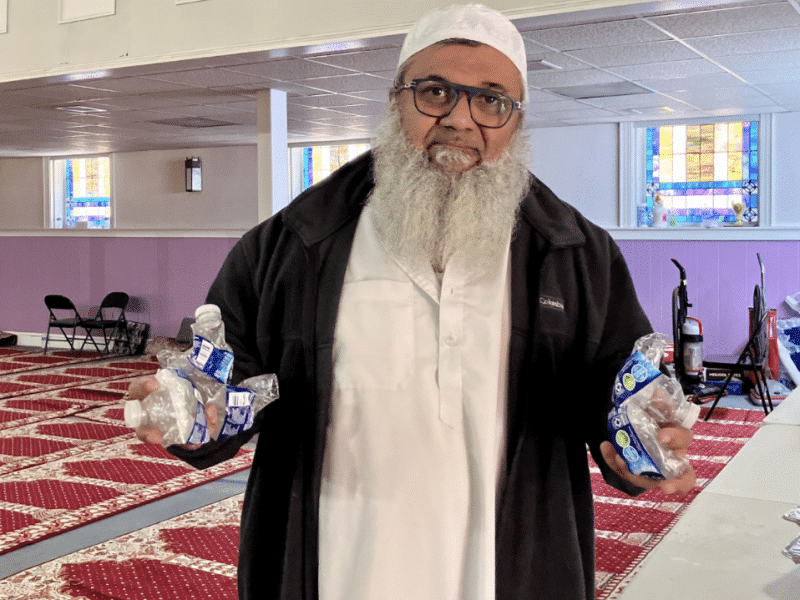
One evening in early March, Nina Ansari frowns as she picks up an untouched plate of rice left on the floor of the masjid she attends near her home in Stone Mountain. “Would anyone like to take this?” she asks a group of women standing nearby. When no one responds, she picks it up. Her hands are already full of the pizza and curry leftovers that her kids didn’t finish. If she doesn’t take the rice home, it will be thrown out. “There’s a lot of waste that happens during Ramadan,” says Nina, 38, who grew up in Georgia.
During the Muslim holy month—a time of spiritual rejuvenation through increased prayer and daylight fasting—masjids may serve hundreds of visitors for iftar, the sunset meal that marks the breaking of the fast. Some also serve a meal in the predawn hours, suhoor, before congregants start their fast.
That all can add up to a lot of trash, though. At mosques in Atlanta and elsewhere, it’s not uncommon to find garbage cans packed to the top by the end of the night, with some plates and plastic water bottles still half full.
“It’s just not acceptable for us,” says Nina. “My family is conscious of water and food conservation. We eat leftovers—we are not wasting or being snooty about wasting.”
Continue reading this article at the site of our news partner 285 South here.

I hope this story leaves you inspired by the power of community-focused journalism. Here at Canopy Atlanta, we're driven by a unique mission: to uncover and amplify the voices and stories that often go unheard in traditional newsrooms.
Our nonprofit model allows us to prioritize meaningful journalism that truly serves the needs of our community. We're dedicated to providing you with insightful, thought-provoking stories that shed light on the issues and stories that matter most to neighborhoods across Atlanta.
By supporting our newsroom, you're not just supporting journalism – you're investing in Atlanta. Small and large donations enable us to continue our vital work of uncovering stories in underrepresented communities, stories that deserve to be told and heard.
From Bankhead to South DeKalb to Norcross, I believe in the power of our journalism and the impact it can have on our city.
If you can, please consider supporting us with a small gift today. Your support is vital to continuing our mission.
Floyd Hall, co-founder