Canopy Atlanta asked more than 90 Collier Heights community members about the journalism they needed. Many residents spoke of the community’s storied past, with comments like “We were tangential to this Black Excellence,” and “It was one of the most prominent neighborhoods.” This story emerged from that input.
Canopy Atlanta also trains and pays community members, our Fellows, to learn reporting skills to better serve their community. Jacinta Daniel, who researched and wrote this story, is a Canopy Atlanta Fellow. La'Niece Littleton, Director of Community Collaborations at the Atlanta History Center, provided research and historical guidance.

It has been over 30 years since I left my home in Collier Heights. It’s been an additional five years since I last smelled her fresh-baked biscuits and fried country ham with the red eye gravy. To put that with some of her grits is something special, and even at my very last meal, I didn’t realize just how special she was.
“Y’all come get this food while it’s hot!”
It wasn’t just the food that made her great. I remember my grandmother getting up at an ungodly time of morning to make sure that her family had a hot breakfast, lunch, and dinner before heading to work or school. Now, this didn’t mean that you could snooze in bed and come in your own time. This meant that when the food was done, she would yell, “Y’all come get this food while it’s hot!” This translated to being up, being clean, being dressed, being ironed, and, for the sake of Jesus, making sure that your hair was looking like something.
You see, Goodmomma, as we referred to her, was not your ordinary grandmother. She was raising four of her thirteen grandchildren, and two who were just living there because the other four were there. Neither here nor there; we all had to get to school, and she had to get to her very corporate job with Coca-Cola in downtown Atlanta. Please understand, she didn’t have to do this feat alone, as my grandfather had to get up with her and help with making sure this daily show got on the road without a hitch.

For a girl who had started out in Plunkett Town—now known as Hapeville, Georgia—this was no small feat.
As a child, I remember visiting her at her office, captivated by the magic she created in her laboratory. At the time, I didn’t fully grasp the magnitude of her role, but looking back, I now understand—she wasn’t merely working behind the scenes; she was one of Coca-Cola’s chemical conjurers. The small, unassuming cups of soda she served during blind taste tests were the foundations for iconic beverages like TaB, Mello Yello, and Minute Maid.

Goodmomma with some of her family
Photo courtesy of Jacinta Daniel
At the end of a long workday, she would often stand by her office window, gazing out at the street that led us back home to Collier Heights. We would wave to our neighbors—Dr. Jane Smith, Mrs. Myrtle Davis, who always had candy waiting for my sister and me, and Mrs. Juanita Abernathy, eager to know when my grandmother would next bake her famous pound cake. These women were more than familiar faces; they were pillars of strength, deeply woven into the fabric of our community. Their presence shaped my childhood, and their legacy continues to shape Collier Heights, standing as a testament to the unwavering spirit of the women who made it extraordinary.
A proud Collier Heights native
In the summer of 1963, my grandparents decided to become homeowners in the most sought-out neighborhood for Blacks in the city of Atlanta. My grandparents found our family’s forever home off Hightower Road going north, turning left onto Collier Drive, and then a sharp right onto Waterford Road, where the Jones family settled.
Fourteen years before my birth, I became a proud Collier Heights native.
While history often highlights the men who designed and constructed this remarkable neighborhood, equally deserving of recognition are the women of Collier Heights—the trailblazers, caretakers, and champions of their community. Their contributions were integral to shaping a legacy of excellence, ensuring that Collier Heights was not only a place to live but a place to flourish.
Among them was my Goodmomma, whose unwavering dedication made a lasting impact. Through their strength, vision, and perseverance, these women helped cultivate a neighborhood that would become an enduring symbol of Black achievement and pride.
To grow up in a community where, behind nearly every door, lived a family of success, legacy, and quiet excellence was something special.
Carve a path worthy of admiration
Just five houses up from Goodmomma’s place lived our family dentist, Dr. Harvey Smith, a renowned Black dentist of Auburn Avenue. I was surprised to learn that Ms. Bazoline Estelle Usher was actually the great-aunt of these neighbors I knew so well.
Usher stands as a monumental figure in the legacy of Atlanta’s educational progress, her name etched into the annals of history through unwavering dedication and an unbreakable commitment to the empowerment of African American children. To be remembered among the greats, one must first carve a path worthy of admiration—and Usher did so with brilliance, resilience, and an unyielding passion for learning.

Bazoline E. Usher
Photo courtesy of the Atlanta History Center

Bazoline E. Usher, Portrait by Judith Sedwick, 1982
Photo courtesy of Wikipedia
Born Basil Estelle Usher on December 26, 1885, she was given a name inspired by an herb her mother frequently used in cooking. However, sensing its masculine tone, she changed it to Bazoline just before departing for college—a fitting decision for a woman who would go on to define her own identity with distinction.
Her remarkable life was recognized with numerous honors, including honorary membership into Phi Delta Kappa Sorority, the Bronze Woman of the Year award from Iota Phi Lambda Sorority in 1946, and the distinguished Scroll of Honor from the Georgia Teachers and Education Association in 1953.
Perhaps her greatest tribute came in 1988 when Harwell Road Elementary School, located in the heart of historic Collier Heights, was renamed Usher Middle School in her honor.
In her own right, Bazoline E. Usher lived an extraordinary life, passing away on February 8, 1992, at the age of 106.
A lifelong commitment to education and leadership
Usher lived out the rest of her life with her niece, Lavada Smith, and family. Usher is the great aunt of Dr. Jane E. Smith. Smith was the daughter of Dr. Harvey Smith, our family dentist and neighbor. Jane Smith inherited not only a legacy of perseverance, but also a remarkable presence that made her one of the most beautiful and distinguished women in the city.
Her academic journey began at Charles L. Harper High School, where she was part of the esteemed 1964 graduating class. But it was at Spelman College—an institution revered for cultivating strong, visionary Black women—that Smith truly honed her passion for sociology, a discipline that would shape her lifelong commitment to education and leadership.
With intellect as sharp as her ambition, Smith ascended through the ranks of academia and public service, earning recognition as a formidable educator and non-profit executive. She carved her path with purpose, becoming the executive director of the Center for Leadership and Civic Engagement at Spelman College and, in 2015, securing the prestigious role of Vice President for College Relations at Spelman College. Her influence extended beyond academia, enriching institutions such as the The Carter Center and the Martin Luther King Jr. Center for Nonviolent Social Change, where her expertise and leadership left an indelible mark.
Yet, beyond her professional accomplishments, Smith held a profound love for Collier Heights, like my Goodmomma.

Dr. Jane E. Smith
Photo courtesy of Spelman College
“You got some pound cake?”
My Goodmomma loved our neighbors. I remember phone calls from Aunt Juanita—known to the world as Mrs. Abernathy—asking, “You got some pound cake?” Sitting next to Aunt Juanita at the Civic League, hearing her speak and course correct, I realized Aunt Juanita was a woman who embodied the true essence of “boots on the ground.” To simply say she lived within the movement would be an understatement–she helped build it, brick by brick, march by march, moment by moment. A stalwart figure in the Civil Rights Movement and one of its most revered mothers, Abernathy was not content to merely bear witness to history; she was determined to shape it.
Juanita Abernathy and her family were among the first residents of Collier Heights, becoming pioneers in one of Atlanta’s most historic African American neighborhoods. She took on the challenge of designing her family’s District 9 home, enlisting the brilliance of Black architect J.W. Robinson to bring her vision to life. With five children to care for, she wasted no time in crafting what would become her sanctuary with her husband, the esteemed Reverend Dr. Ralph David Abernathy Sr. dream that would transform a nation.
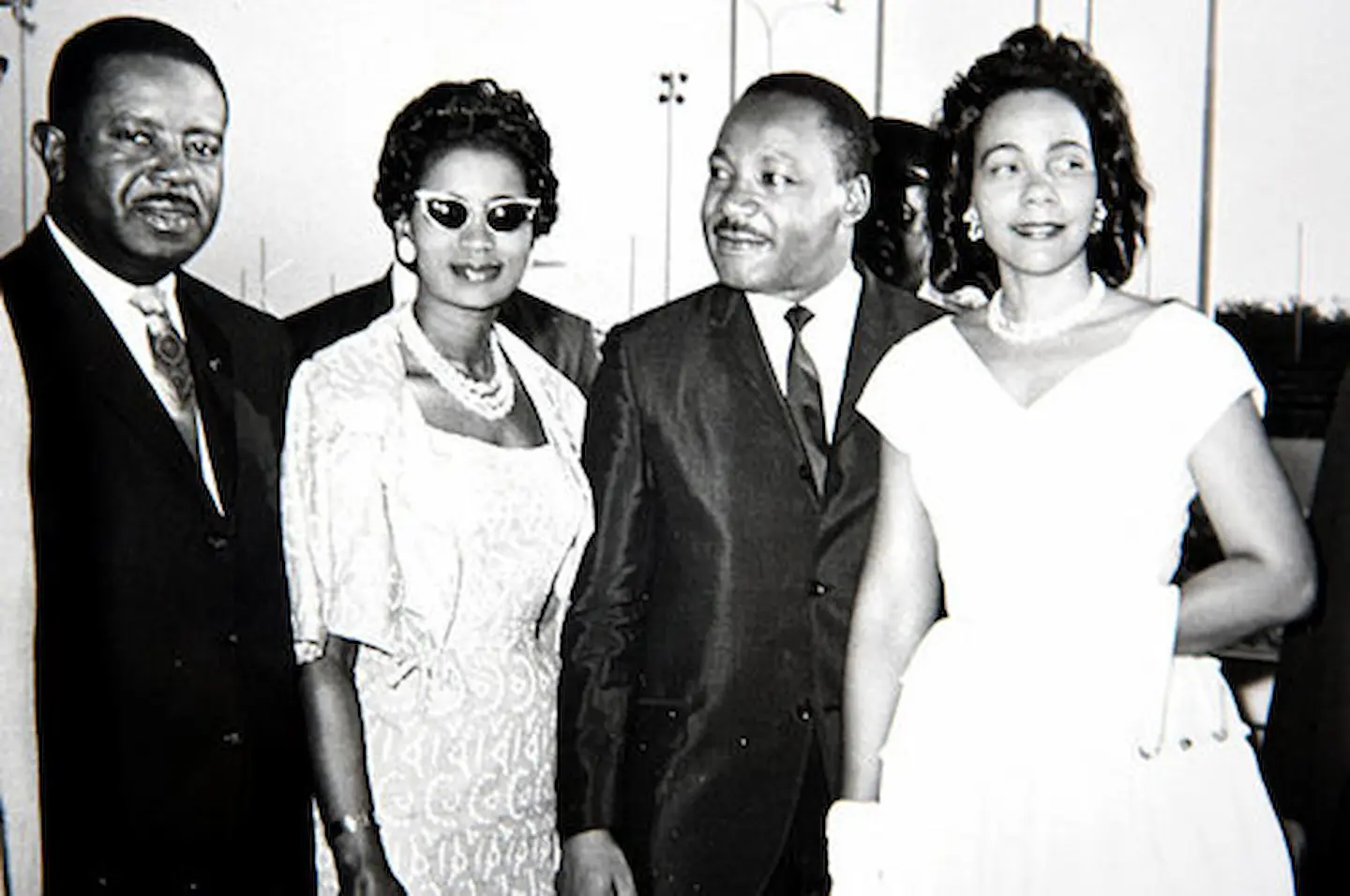
Photo courtesy of the Atlanta History Center
But adversity never deterred Juanita Abernathy—she was never one to stand idly by while change unfolded. As the First Lady of West Hunter Street Baptist Church, she took on the responsibilities of both a spiritual leader and a community advocate. Her academic journey led her from Selma University to Tennessee State University in Nashville, where she graduated with the determination to uplift and empower. Her brilliance extended beyond education; she was a formidable businesswoman, earning the role of National Sales Director at Mary Kay Cosmetics.
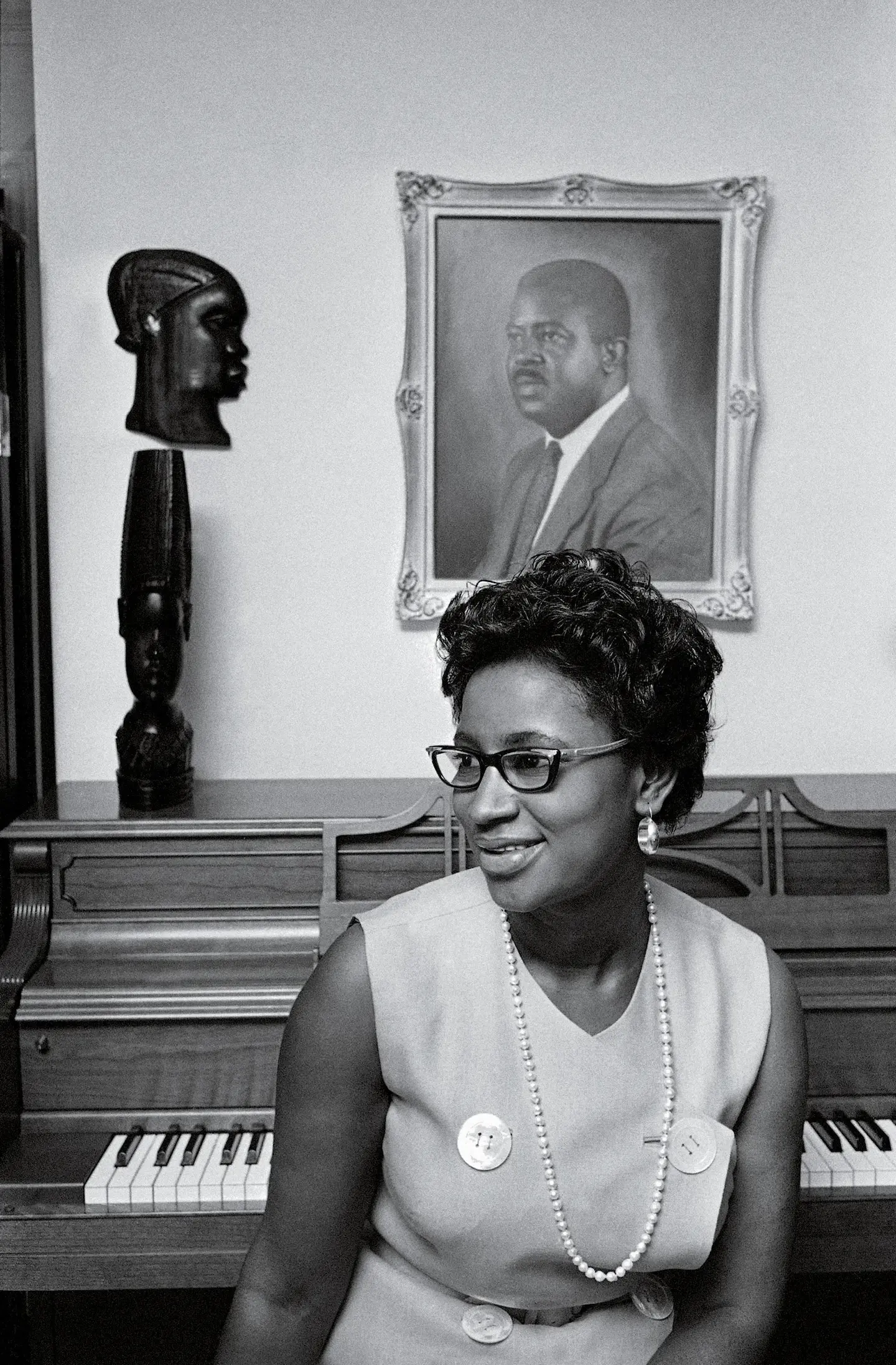
Juanita Abernathy
Photo courtesy of the Atlanta History Center
Her leadership stretched across civic engagement, serving on the board of Morehouse School of Religion, MARTA, and the Atlanta Fulton County League of Women Voters.
In every room where progress was debated, in every meeting where the future of Collier Heights was shaped, Abernathy’s presence was felt. Her voice was firm, her commitment unwavering. She was the heartbeat of her community—addressing concerns, fighting for advancement, ensuring that Black prosperity was never just a dream, but a reality.
When she passed in 2019, the world lost a giant.
“Her life was a testament to the towering role that women played in the Civil Rights Movement. The men received most of the credit, but behind the scenes, women were often the doers, the organizers, and advocates who formed the backbone of the struggle.”
In his tribute, the late Congressman John Lewis honored her legacy with words that captured her essence, saying, “Her life was a testament to the towering role that women played in the Civil Rights Movement. The men received most of the credit, but behind the scenes, women were often the doers, the organizers, and advocates who formed the backbone of the struggle.”
Aunt Juanita was more than a participant in history—she was its architect, its warrior, and my Goodmomma’s good friend.
Our very own “Candy Lady”
Collier Heights might be known for its historic homes, but it was the stretch of yards and gardens from house to house that truly brought the women together.
That’s where the ladies of the neighborhood—Goodmomma, Aunt Juanita, and Ms. Myrtle—would gather, swapping the latest gossip while oohin’ and ahhin’ over how pretty Ms. Myrtle’s flowers were.
Davis, who was a premier pharmacist and Atlanta City Council Member, lived directly across the street from Usher and Smith. Married to activist and Atlanta physician Dr. Albert M. Davis, this power couple not only took on Collier Heights by storm but also helped to shape the dynamics of the day-to-day standard operating procedures for the City of Atlanta. She was our very own “Candy Lady” and my Goodmomma’s gardening partner.

Myrtle Davis
Photo courtesy of the Atlanta History Center
Video courtesy of the HistoryMakers Digital Archive
I grew up knowing Collier Heights women to be bold thinkers and boundless dreamers. A foundation for success through determination, lifelong connections, pursuing their own ambitions, and caring for the future—Bazoline Usher, Dr. Jane E. Smith, Juanita Abernathy, and Myrtle Davis. And yes, Goodmomma, known to her friends and colleagues as Susie Jones.
Goodmomma was making history
Susie Jones lived her life with the kind of grace that didn’t ask for attention—but always earned it. Every morning, she rose with purpose, waking the house before heading off to do the work that shaped the future of Coca-Cola. My grandmother told me she wasn’t just mixing drinks—she was curating flavors, refining formulas, putting them through blind taste tests until the best rose to the top. Her days were a dance between chemistry and creativity, discipline and instinct.
But it wasn’t all lab coats and calculations. Around lunchtime, she’d slow down to share a hot meal with Roberto Goizueta. Over plates and paper notes, they’d trade ideas, debate innovations, and imagine what the next beloved drink might be. It was a ritual—half science, half heart.
And when Goodmomma stepped off the elevator in the Tech Building, pride wrapped around her like a silk shawl. She turned the key, flipped the lights, and walked into an office that read Susie Jones on the door. Not just a name, but a legacy. Behind that door, past a cluster of taste-testing rooms, was a lab built like a kitchen and a kitchen built like a think tank. It was her space—equal parts brilliance and hospitality. And as she stood there, surrounded by the life she’d made, it was clear: she wasn’t just making drinks. Goodmomma was making history.
“I remember the women of Collier Heights to be the ones who laid down legacy like bricks, who stirred strength into every pot, and spoke life into their gardens and their families.”
Spending time with Goodmomma and her friends was a gift I didn’t realize throughout my life. The smell of fresh biscuits and country ham still lingers in my core memory like Sunday morning. These days, I’ve become the “Ms. Myrtle” of my own block—making sure the kids always have a piece of candy, just like she did for my sister and me while the womenfolk talked flowers and city hall.

Goodmomma with some of her family
Photo courtesy of Jacinta Daniel
Now, I’ll admit—I got put out of Girl Scouts. Sorry, Ms. Bazoline. Camping just wasn’t my thing. But I’d like to think I made up for it every time I cut Aunt Juanita a slice of pound cake. And thanks to your influence on Dr. Jane Smith, I knew early on that education would be my lighthouse, steady and guiding, no matter the storm.
I remember the women of Collier Heights to be the ones who laid down legacy like bricks, who stirred strength into every pot, and spoke life into their gardens and their families. Their names are hymns, their lives a testimony—and when I listen close, I can still hear my Goodmomma and her friends whisperin’ wisdom to me.
Editor’s Note: Charles L. Harper High School was incorrectly identified as Charles H. Harper High School when this story was initially published on Saturday, June 14, 2025. The school name was corrected on Wednesday, June 18, 2025.
Editors: Ann Hill Bond and Mariann Martin
Historian: La’Niece Littleton
Fact Checker: Ada Wood
Canopy Atlanta Reader: Genia Billingsley
I hope this story leaves you inspired by the power of community-focused journalism. Here at Canopy Atlanta, we're driven by a unique mission: to uncover and amplify the voices and stories that often go unheard in traditional newsrooms.
Our nonprofit model allows us to prioritize meaningful journalism that truly serves the needs of our community. We're dedicated to providing you with insightful, thought-provoking stories that shed light on the issues and stories that matter most to neighborhoods across Atlanta.
By supporting our newsroom, you're not just supporting journalism – you're investing in Atlanta. Small and large donations enable us to continue our vital work of uncovering stories in underrepresented communities, stories that deserve to be told and heard.
From Bankhead to South DeKalb to Norcross, I believe in the power of our journalism and the impact it can have on our city.
If you can, please consider supporting us with a small gift today. Your support is vital to continuing our mission.
Floyd Hall, co-founder