
Two very opposite things can be true at the same time. It can be the best of times for some and the worst for others. Nowhere is this paradox more visible than in Atlanta—where a single street can separate prosperity from poverty.
In a conversation with longtime residents of Collier Heights, one of Atlanta’s oldest and proudest Black neighborhoods, I was struck by the stories they shared. They recalled seeing millionaires like Herman J. Russell driving modest cars, with no pretense or flash. To them, a legendary name was a neighbor. It was a community where excellence was ordinary, and success felt attainable.
About the same time, I came across a post in Vanishing Black Atlanta History, a Facebook group curated by historian Skip Mason. A woman named Tammy Sutton was searching for her mother, who had once lived in Bowen Homes. That public housing project is located just across from Collier Heights, on the other side of Donald Lee Hollowell Parkway (formerly Bankhead Highway).
In response, a former teacher shared a memory of a second-grade student from Bowen Homes whose last name was Sutton.
She wrote:
“I think of that boy often. He was such a great kid, smart, responsible, so pleasant. I remember him asking for money once, I said no sir, for u to spend it w the candy lady! He said no, my mom had been gone for a couple of days and I’m going to buy me and my little sister some noodles!”
That teacher was Alanda Boyd. I reached out to Alanda, and she shared her story.
Fresh out of Miles College, Alanda began her teaching career at A.D. Williams Elementary, a school located across the street from Bowen Homes. Hired late in the year, she was given the students no one else wanted. “They was jumping on the tables. It was like Dangerous Minds, standing on the chairs,” she laughs.
With no textbooks or resources, Alanda leaned on her parents, who bought workbooks and supplies so she could teach. She quickly learned her role was much bigger than delivering lessons. “I think they probably felt loved and kind of mothered and, you know, family,” she says.
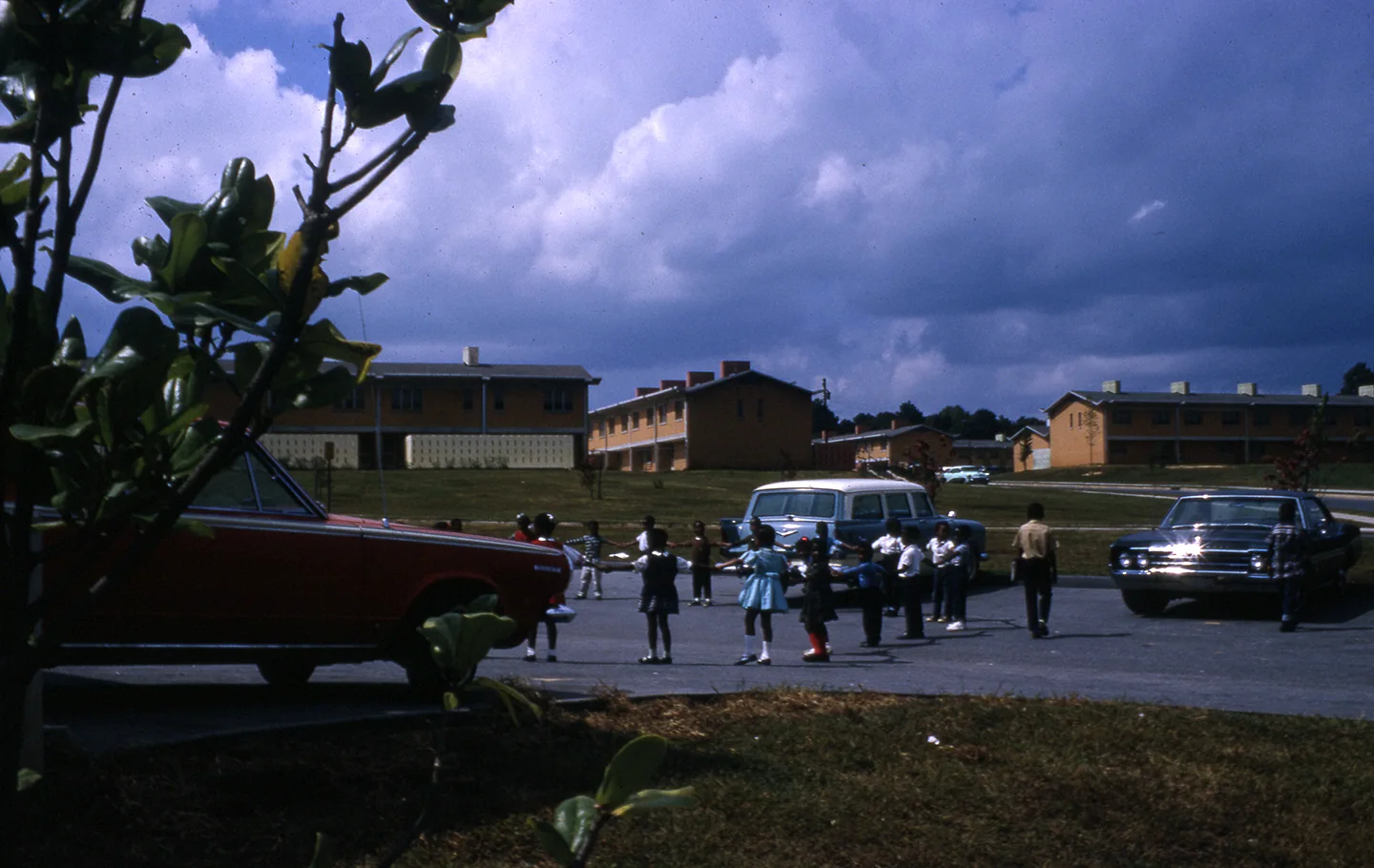
Schoolchildren form a circle to play outside in Bowen Homes, before the public housing project was razed in 2009. Photo courtesy of Atlanta Housing.
Alanda often used her own paycheck to buy food for students’ families. She remembers one mother asking for help; Alanda took off work to drive her to the grocery store in her own car. “You didn’t want to be on Bankhead when it was dark . . . That’s [what] they used to tell us,” she says.
Alanda and her husband even hosted her class at their home in Marietta for a cookout and slip-and-slide party. “Some of them had not been downtown,” she says.
Meanwhile, just across Hollowell Parkway, children in Collier Heights were growing up surrounded by models of Black excellence. On one side of the street, success was the norm. On the other side, children shouldered adult responsibilities before they’d even mastered long division.
How does this happen?
How can wealth exist in plain view of hunger?
The answer lies not in personal choices, but in systems—housing policies, redlining, school funding, and transportation planning—that for generations drew invisible but immovable lines across Atlanta.
Alanda left A.D. Williams after three years, but the lessons and the students have never left her. She remembers their names and keeps their pictures. Today, she runs A+ Educational Concierge, continuing her mission to serve students who need more than lessons.
Atlanta is often described as a Black Mecca, and that is true. But it’s also true that it remains one of the most unequal cities in the country, where a child’s future is determined by which side of the street they live on.
Both truths can exist at once.
And let’s not forget: the lines on maps and city planning documents were drawn by people—they are not real. They are imaginary boundaries that should never decide who we consider a neighbor or who belongs in our community.
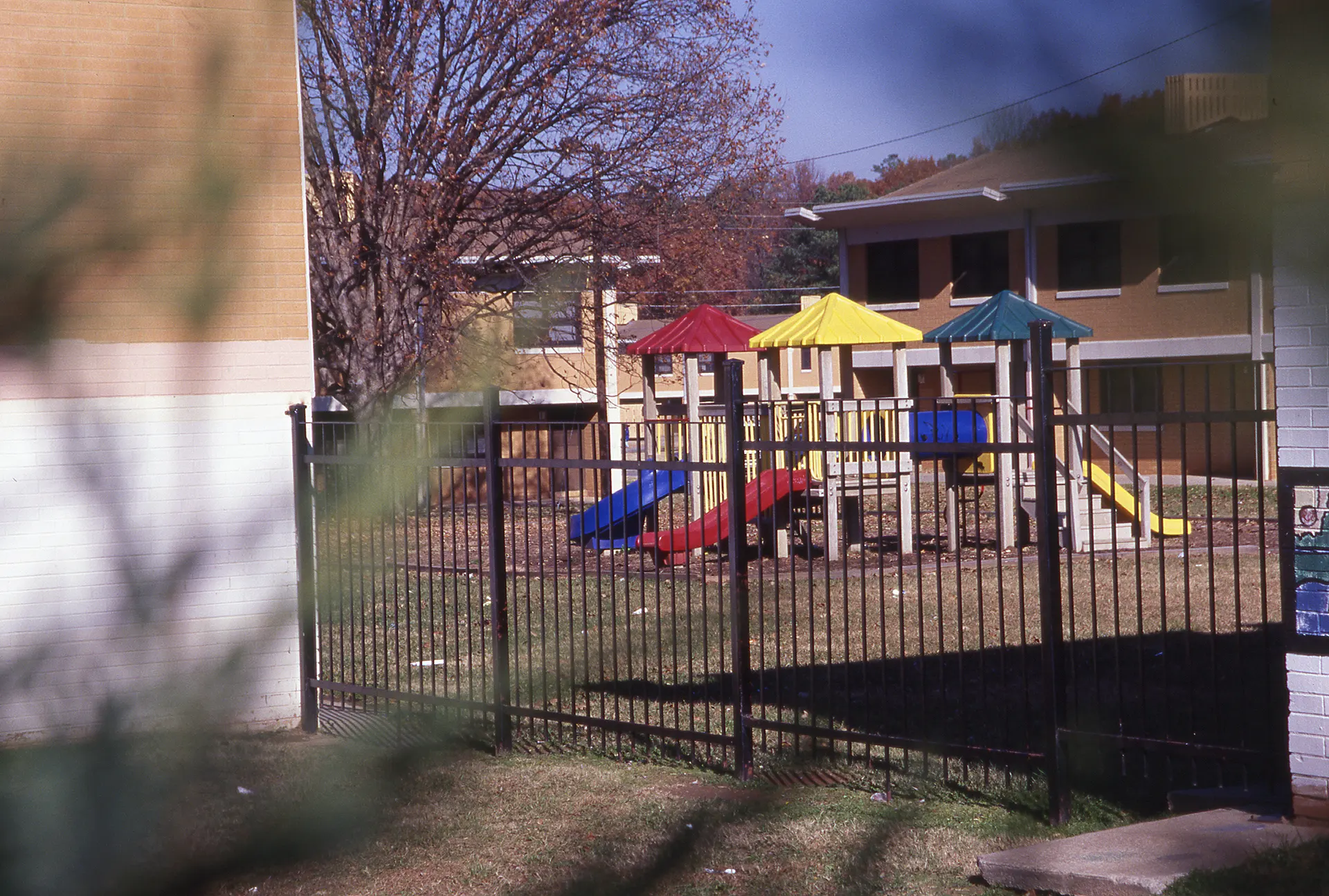
A view of a playground in Bowen Homes. Photo courtesy of Atlanta Housing.
Editors: Ann Hill Bond and Mariann Martin
Fact Checker: Ada Wood
Canopy Atlanta Reader: Heather Buckner
I hope this story leaves you inspired by the power of community-focused journalism. Here at Canopy Atlanta, we're driven by a unique mission: to uncover and amplify the voices and stories that often go unheard in traditional newsrooms.
Our nonprofit model allows us to prioritize meaningful journalism that truly serves the needs of our community. We're dedicated to providing you with insightful, thought-provoking stories that shed light on the issues and stories that matter most to neighborhoods across Atlanta.
By supporting our newsroom, you're not just supporting journalism – you're investing in Atlanta. Small and large donations enable us to continue our vital work of uncovering stories in underrepresented communities, stories that deserve to be told and heard.
From Bankhead to South DeKalb to Norcross, I believe in the power of our journalism and the impact it can have on our city.
If you can, please consider supporting us with a small gift today. Your support is vital to continuing our mission.
Floyd Hall, co-founder