
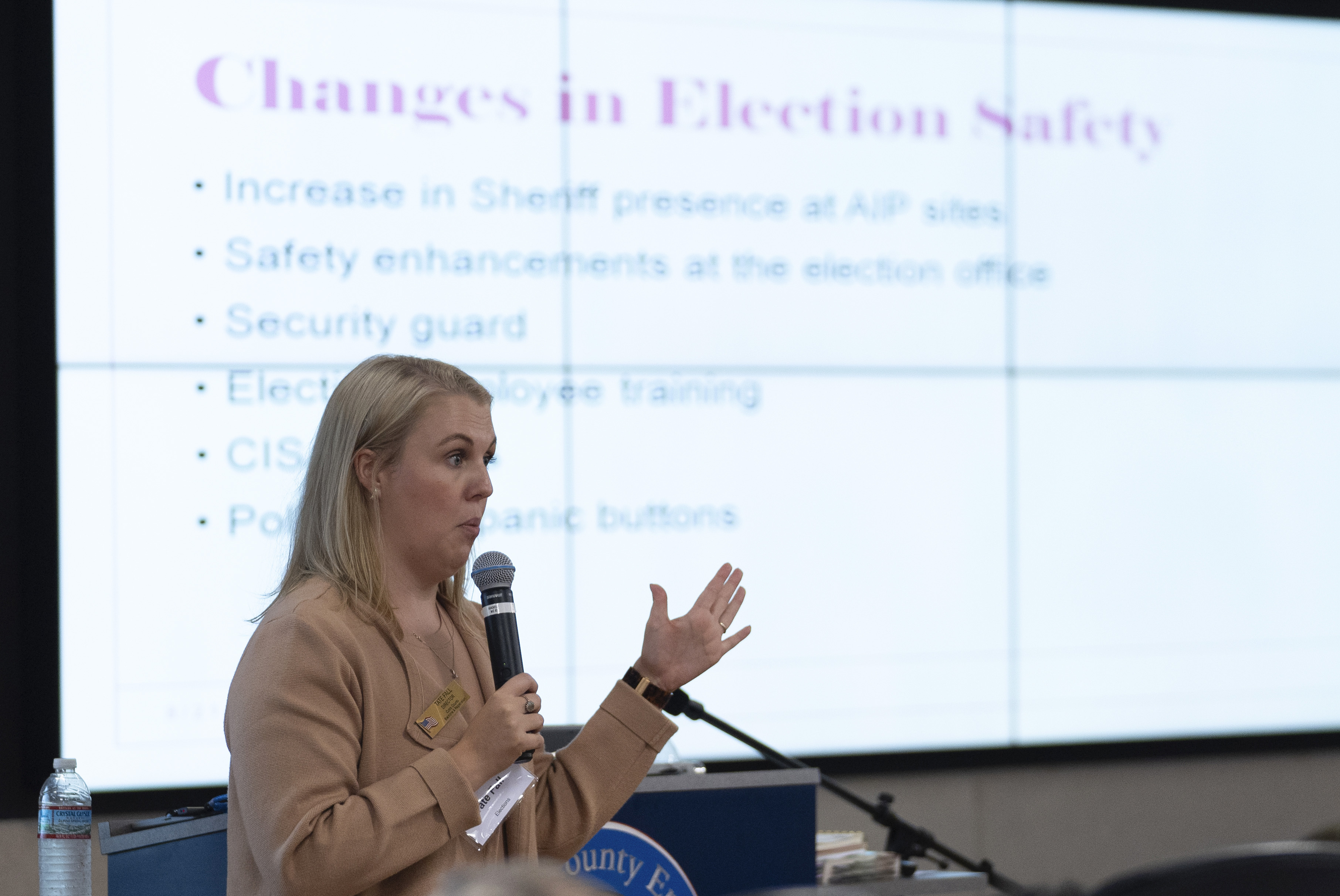
MARIETTA, Ga. (AP) — The election director in Cobb County, an Atlanta suburb where votes will be fiercely contested in this year’s presidential race, recently organized a five-hour training session. The focus wasn’t solely on the nuts-and-bolts of running this year’s election. Instead, it brought together election staff and law enforcement to strategize on how to keep workers safe and the process of voting and ballot-counting secure.
Having a local sheriff’s deputy at early voting locations and panic buttons that connect poll managers to a local 911 dispatcher are among the added security steps the office is taking this year.
Tate Fall, Cobb County’s election director, said she was motivated to act after hearing one of her poll workers describe being confronted during the state’s presidential primary in March by an agitated voter who the worker noticed was carrying a gun. The situation ended peacefully, but the poll worker was shaken.

“That made it really real for me — that it’s so easy for something to go sideways in life, period, let alone the environment of Georgia and elections,” said Tate Fall, Cobb County’s election director. “I just can’t have someone being harmed on my conscience.”
Across the country, local election directors are beefing up their security in advance of Election Day on Nov. 5 to keep their workers and polling places safe while also ensuring that ballots and voting procedures won’t be tampered with. Their concern isn’t just theoretical. Election offices and those who run them have been targets of harassment and even death threats since the 2020 presidential election, primarily by people acting on former President Donald Trump’s lies that the election was stolen from him through widespread fraud or rigged voting machines.
The focus on security comes as threats of political violence have been on the rise. Trump was the target of a potential assassination attempt over the weekend, just nine weeks after another threat on his life. Federal agents last year fatally shot a Trump supporter who threatened to assassinate President Joe Biden, and the husband of former House Speaker Nancy Pelosi was severely injured in a hammer attack by a man promoting right-wing conspiracy theories.

Maj. Larry White of the Cobb County Sherriff’s Department, listens to a speaker during an election security training session at Cobb County Emergency Management headquarters, Aug. 23, 2024, in Marietta. (AP Photo/John Bazemore)
In just the last year, a gun was fired at a window of the Cuyahoga County, Ohio, election office, several election offices in five states were sent letters filled with a white powder that in some cases tested positive for the powerful opioid fentanyl, and bogus 911 calls were made to the homes of top state election officials in Georgia, Maine, Michigan and Missouri in a potentially dangerous situation known as swatting.
“This is one of the things that I have to say is just crazy, outrageous to me — the election threats to workers of both parties and their families, the bullying, the harassment,” Jen Easterly, director of the U.S. Cybersecurity and Infrastructure Agency, said during a recent agency-sponsored online event. “These folks, they are not doing it for pay. They’re not doing it for glory. They’re doing it because they believe it’s the right thing to do to defend our democracy.”
Her agency has completed more than 1,000 voluntary physical security assessments for election offices since the start of 2023. Election officials have been using that help to identify gaps and request money from their local governments to make upgrades.
They also have been aided by a U.S. Election Assistance Commission decision in 2022 that allowed certain federal money to go toward security features such as badge readers, cameras and protective fencing.
Election officials say security is a balancing act, ensuring safety while making sure polling places are welcoming spaces for voters and providing enough access to election offices so the public can trust the process.
In Michigan four years ago, a large crowd of Trump supporters created a tense and chaotic scene when they gathered outside Detroit’s ballot counting operation the day after the election, chanting “Stop the count!” as they banged on the windows and demanded access.
Detroit City Clerk Janice Winfrey said her office is much better prepared this time, with more cameras, armed security and bulletproof glass. Observers will now be checked in and screened by security outside a large room used for counting ballots at the city’s convention center.
“My biggest concern was to protect the staff and the process,” Winfrey said. “And in doing so, our building — it may look the same, but it’s not the same.”