Canopy Atlanta asked over 140 Tri-Cities community members about the journalism they needed. This story emerged from that feedback.
One resident in particular expressed concern over the polluted South River, as well as plants owned by PPG Industries and William C. Meredith Company. “Air pollution issues are a big problem in East Point,” she said.

Within weeks of moving into our house in East Point in 2005, I noticed the smell, a sickeningly sweet haze.
“That’s creosote,” my neighbors told me one evening, “from the telephone pole plant.”
Our real estate agent hadn’t mentioned this neighborhood feature—how I had moved within less than one mile from several chemical plants. A utility-pole treatment plant owned by the William C. Meredith Company occasionally emitted a haze of chemicals including creosote, a wood preservative distilled from coal tar.

East Point, College Park, and Hapeville are railroad towns that developed in the mid-19th century, before zoning laws protected residential areas from industrial areas. African Americans were forced to live in an East Point neighborhood called East Washington next to steel, oil, and fertilizer plants such as the Old Dominion Guano Co. They were restricted by law to living in the bottoms, which were the worst polluted districts downstream.
My grandfather, Fred Slagle, spent two decades working at the Prestolite battery plant on Lawrence Street. He was almost retired by the time the Occupational Safety and Health Administration was established to protect workers, and environmental regulations like the Clean Air Act and the Clean Water Act provided all of us some protections from industrial pollution. Grandaddy lived into his 90s. But like many of the plant workers, he lost his teeth early thanks to exposure to battery acid.
According to geospatial data presented by Hummingbird Firm and Partnership for Southern Equity, more than 2,400 residential parcels sit within 1,000 feet of East Point’s industrial zones. That’s 25 percent of residential parcels in the city.
For years after I moved to East Point, whenever I noticed the creosote smell, usually on foggy evenings while driving past what was then public housing at Hillcrest Homes, I rolled up my car windows and tried not to breathe.
But I was also digging further into the source, joining the ranks of Tri-Cities residents who spend their nights and weekends fighting to clean up old pollution and working to stop new polluters from moving next door. It’s hard, troubling work. So what keeps so many of us fighting for this place we call home?
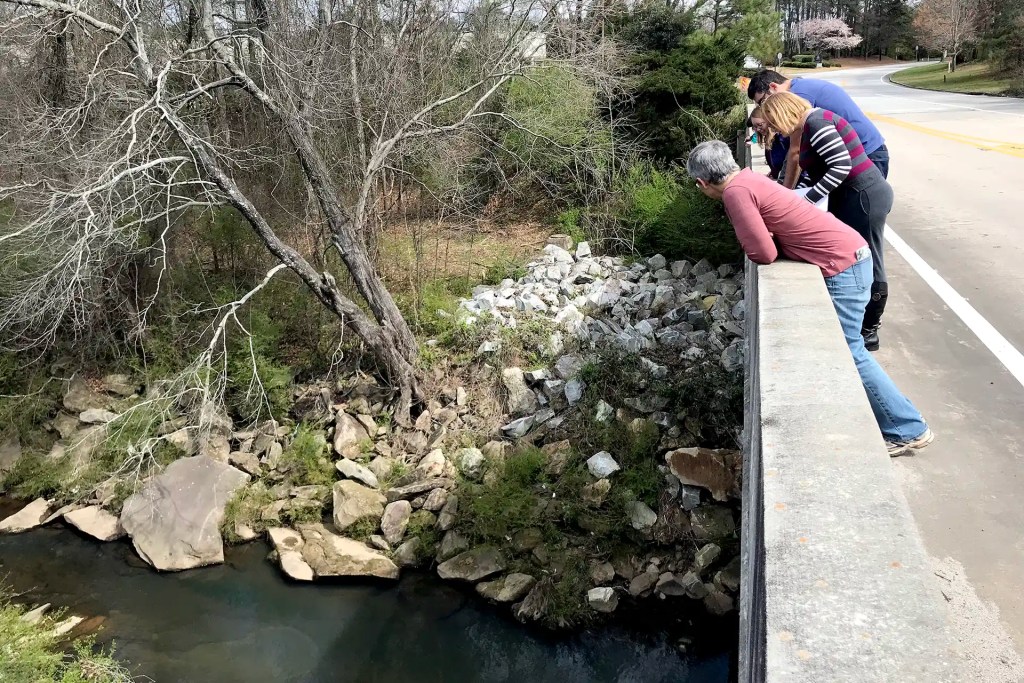
In 2004, an investigation by the CDC’s Agency for Toxic Substances and Disease Registry found wood preservatives in the urine of not just East Point residents, but also a researcher who visited the area. In 2007, community members sued the William C. Meredith Company in response—and lost. Essentially, it’s hard to prove that one company is responsible when there are multiple polluters in the area.
I learned about the lawsuit from Carrie Ziegler, who noticed these chemical odors when she moved to Jefferson Park in 2017. In 2018, she helped form the East Point Environmental Collective (EPEC), which later won a grant from Emory University to study East Point’s industrial odors and monitor air quality.
I met Carrie that year, when she brought EPEC members to one of my community tours of the Flint River’s headwaters around the airport. While researching for my book Flight Path, about how the expansion of Hartsfield-Jackson Atlanta International Airport degraded and erased Southside neighborhoods, I learned about the Flint River, which is piped for nearly two miles under the runways. I helped found the Finding the Flint campaign to argue that the swaths of forest along the river corridor are not a sacrifice zone for the airport, but our best protection from noise, air, and water pollution, not to mention rising temperatures.

Ziegler and the EPEC started showing up to meetings for local boards like East Point’s Business and Industrial Development Authority, using public comment to oppose harmful industrial development in the area. In 2023, she ran for a seat on the East Point City Council and won. Progress, she told me, “starts with the city council appointing people who are aware of what’s going on these boards, who are also invested and have some kind of public health knowledge, and also have a better vision of East Point, that we’re not just some industrial wasteland.”
EPEC wound down its activities, but as a community-led campaign mobilizing citizens and pushing for a more just, green vision of the Southside, it definitely had an impact. From EPEC, I learned that the fight for environmental justice moves in increments. If you can focus on one issue, raise awareness, and activate a campaign, that’s success.
Mose James IV and I are about the same age, and part of the generation of Southside natives, Black and white, who have chosen to stay in the Tri-Cities to raise our families.
On March 18 of this year, James was listening to a livestream of a College Park City Hall meeting.
“I’m literally sitting at my countertop with my son, helping him with his homework. I have my laptop to the side. I’m not really focusing, but there’s just this back and forth about rezoning . . . You hear the mayor asking, what is the address? Then I heard them say, 0 Welcome All Road.”
Zero Welcome All Road is a 62-acre greenfield site that spans the backside of the Sunrise neighborhood where James grew up. While this working class Black community is in the city of South Fulton, across the city limits in College Park, the owners of 0 Welcome All Road, NextEra Energy, wanted to rezone it from “business park” to “light industrial” to build a lithium battery storage facility.
For years, fearing the risk of explosions and uncontrollable fires in their backyard, Sunrise community members teamed up with Delano Road residents to fight the rezoning. Twice, residents shared their concerns before College Park City Council. And twice, the council voted to deny rezoning.
Seven months and one election later, the proposal resurfaced during that same city council meeting that James was hearing—this time, without prior notice of the vote to residents. James hopped into his car and raced to College Park City Hall to make a public comment.
“Now this council is creating a situation to devalue our first opportunity at being able to pass something along to our children, and it hit me hard,” he says.
Often, this is what the fight for environmental justice looks like: hustling to City Hall when you’d rather be at home. It takes years to follow an issue over time and identify the right place and moment to confront power.
In College Park, the lithium battery plant is a case study in environmental injustice.
Unfortunately, College Park’s recently elected council voted to approve rezoning the land without giving James or anyone else the opportunity to speak.
“What frustrates me the most, because I grew up here, [is that] I’ve always waited for our opportunity,” he said. “And then instead, there’s people in our government that are just accepting the crumbs on the table.”
James helped found United College Park, a group of concerned residents protesting the lithium battery storage plant and pushing for better city council transparency. When College Park’s mayor asked the state Attorney General to investigate the rezoning process, United College Park started a GoFundMe for $10,000 to retain an attorney.
As a graphic designer and video producer, James also turns long-winded city council meetings into more digestible clips on his YouTube channel. He has realized that politicians and developers need to be held accountable.
When NextEra Energy—a company whose worth fluctuates between $150 and $175 billion—drops an undesirable infrastructure project into a working class Black community, this is not climate justice. Even if the lithium batteries never explode or catch fire, a 60-acre battery plant will change the character of the neighborhood forever.
That community loses all the value of the greenspace—the privacy, noise buffer, shade, stormwater protection, and natural beauty—and gets stuck with a humming power plant forever.
“At what point did we finally just get, you know, a garden?” James says. “At what point do we finally get the amenities that are elsewhere, instead of you continuing to pile this on us?”
In College Park, the lithium battery plant is a case study in environmental injustice.

You can easily forget about Atlanta’s industrial past, so thoroughly have its mills and factories been transformed into urban playgrounds. In East Point, this is happening slowly, as each new brewery and art gallery pushes up against its industrial neighbors.
My family and I are the target market for this kind of redevelopment, having just enough disposable income to enjoy it. But I find it unnerving to do yoga or sip craft beer knowing what kind of remediation work it takes to turn a brownfield into a biergarten.
The Tri-Cities’ small-town vibe means that we have a tight-knit community where we know our neighbors. And the short distance to City Hall makes it feel like a place where we can make a difference.
I often hear from ordinary people who ask questions but are frustrated by how hard it is to get answers: Is it safe to walk my dog and breathe these obnoxious odors? How bad is air pollution around the airport? Do airplanes dump jet fuel on us? Can I grow and eat vegetables from my yard?
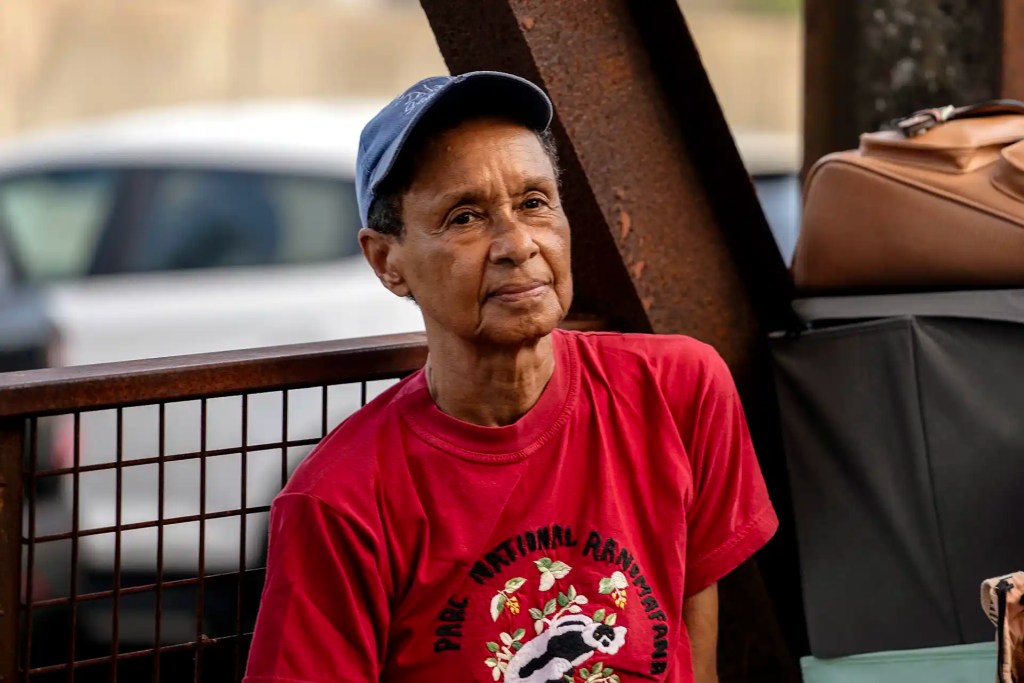
Opal K. C. Baker (top image), who has lived in East Point for nearly 13 years, reached out to me two years ago with a common sense question: Why is that water blue?
During one of her long walks during the pandemic shutdown, Baker noticed a milky turquoise creek flowing around a public housing project, behind a public elementary school, and through a public playground: the South River headwaters.

At Kupcakerie, I told her that the neon blue stream has been that way for as long as anyone can remember, with struggling aquatic life and—as I’ve seen myself—the pH of vinegar. The main culprit is the Tift site, an industrial landfill that Georgia’s Environmental Protection Division (EPD) listed as a highest priority site in 1995 but never remediated. Contaminants identified in the soil and groundwater included lead, arsenic, mercury, and copper.
Baker went on to graduate from the Atlanta Watershed Learning Network, the same community training program that launched Atlanta City Council representative Jason Dozier. In June, two years after our coffee date, Baker convened an energetic group of residents at the Atlanta Utility Works, a compound of industrial buildings and ruins that now house an event space and brewery, to bring attention to contamination in the South River headwaters.
-
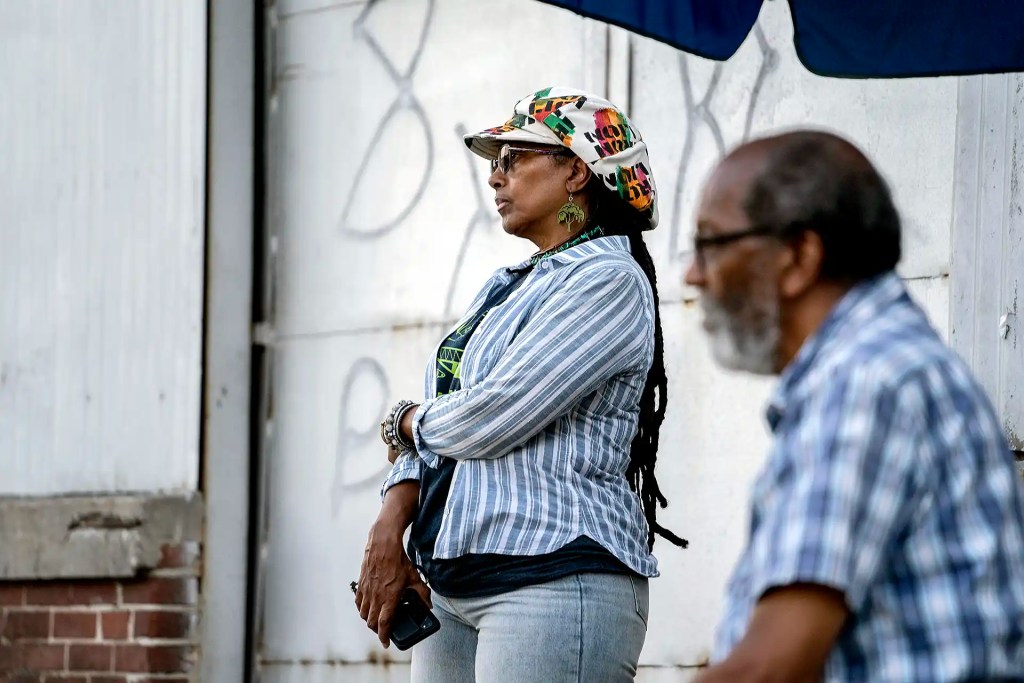
Opal K.C. Baker (center) has led meetings discussing the impact of the South River in and beyond Tri-Cities. -
-
-
-

-

-
-
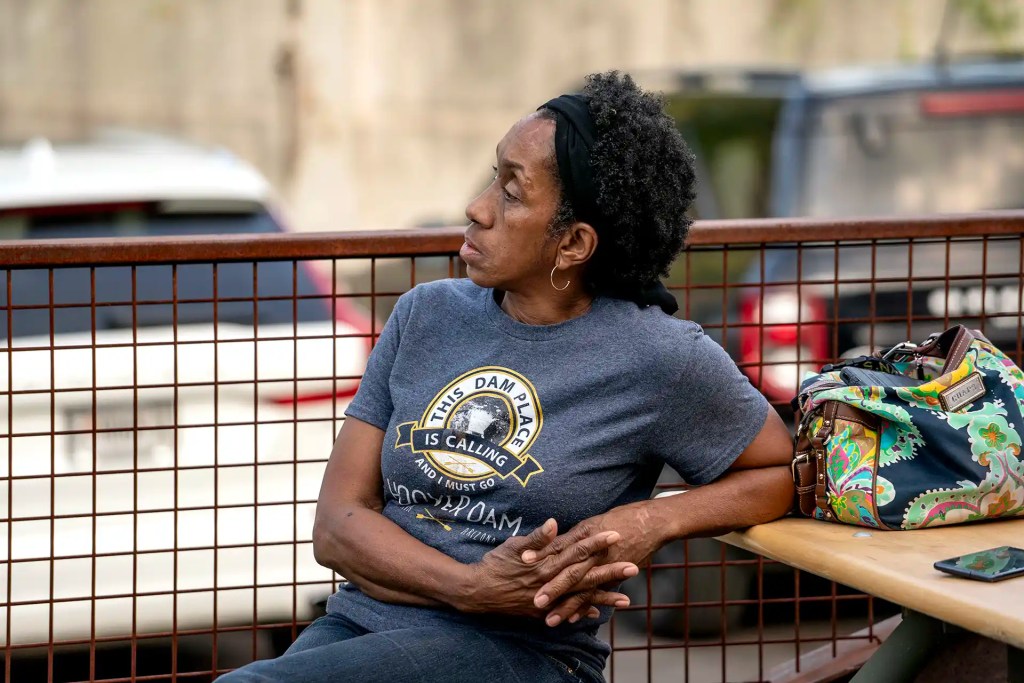
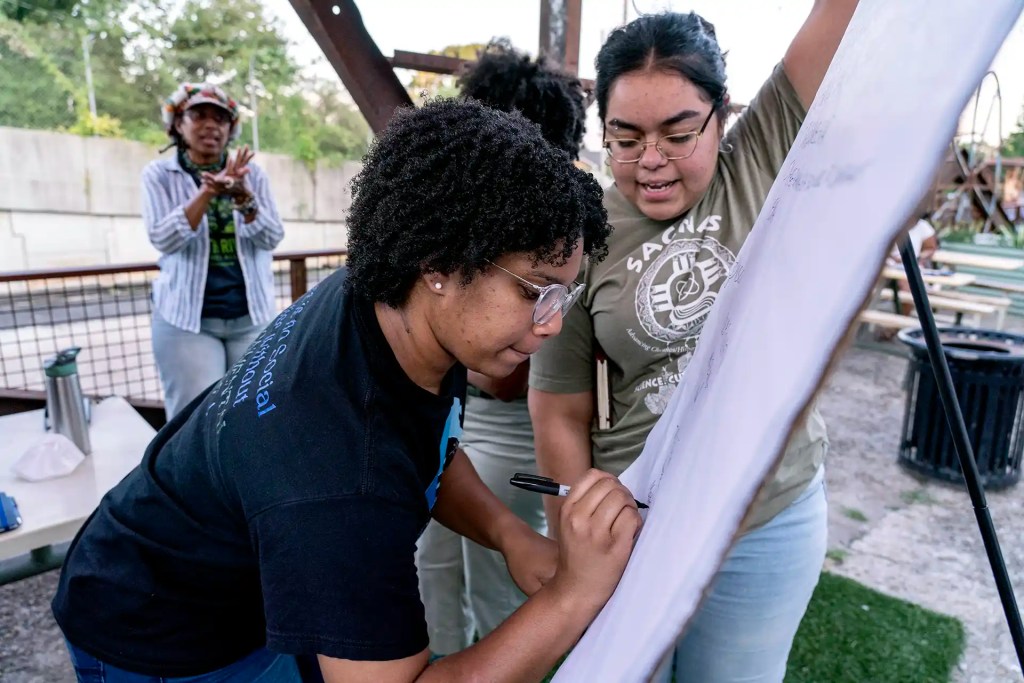
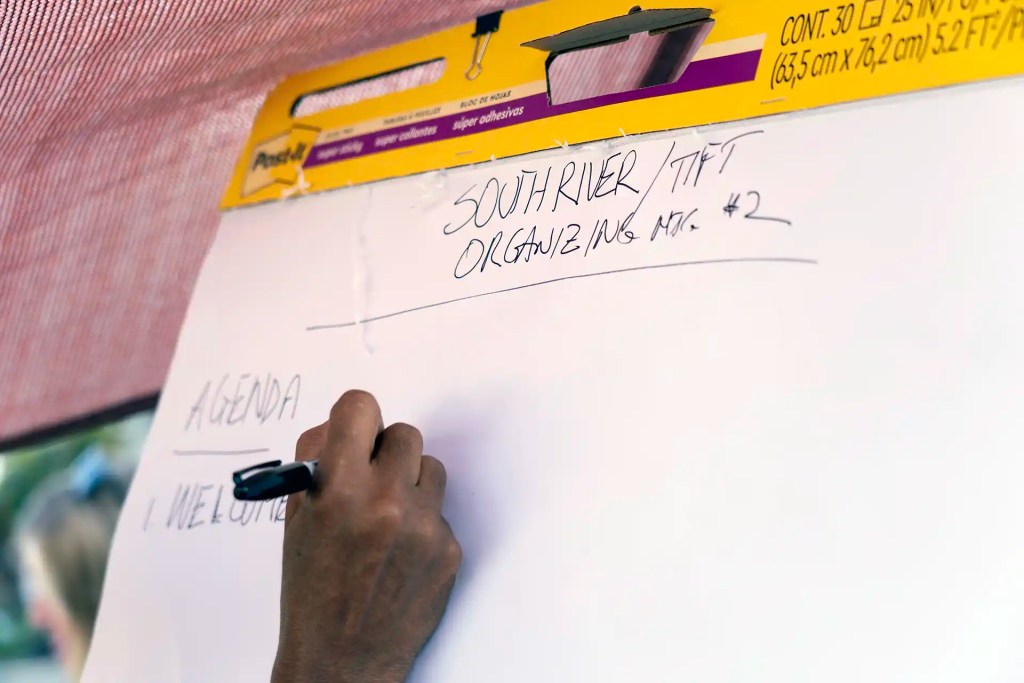
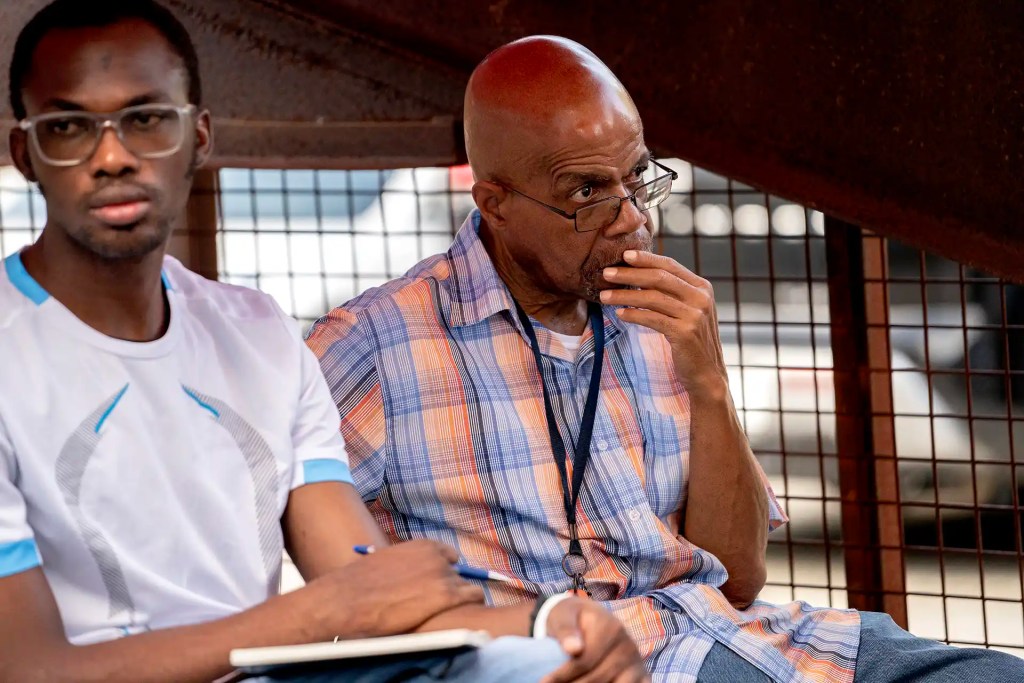
In August 2024, Tri-Cities residents met to discuss how the polluted South River impacts public health. Photos by Dean Hesse
In attendance were community advocates not just from Tri-Cities, but from other majority Black, Southside communities affected by similar environmental justice issues, from South Fulton to Stonecrest. A sign pointing to the entrance read “Why is that Water Blue?”
For two hours, neighbors, scholars, and environmental and public health advocates took turns with a PowerPoint, sharing their knowledge about the legacy pollution downstream of the Atlanta Utility Works and the state’s stalled efforts to initiate a clean-up.
I had been waiting for this meeting since I first saw the sickly blue water myself back in 2018. I had been storing up my research, and my outrage. Finally, here was an outlet—and a group of people who cared as much as I did. I was unexpectedly emotional when I took the mic, confessing that after reading the EPD’s files, I was scared to allow my children to play at a nearby park.
“The fact that we are even having this conversation about environmental justice is a reminder for me that we’re not free,” Baker says. “We still have to fight to breathe clean air. We have to fight to drink clean water. We have to fight to grow our food in uncontaminated soil. All of those things put limitations on our lives.”
I still live in the same house that we bought in 2005. The old Hillcrest Homes have been redeveloped into some nice senior apartments. New galleries and walking trails invite new neighbors to buy a home here.
Eventually they’ll smell the creosote and ask me about it. What they’ll learn is that we have work to do.
Editor: Christina Lee
Fact Checker: Marlowe Starling
Canopy Atlanta Reader: Mariann Martin
Clarification made Friday, October 11: This story initially described Hillcrest Homes as a retirement community. It has been updated to reflect that when Hannah Palmer first lived in East Point, Hillcrest Homes was a housing project managed by East Point Housing Authority, where families with young children lived. Hillcrest Homes was only recently redeveloped as a retirement community.
I hope this story leaves you inspired by the power of community-focused journalism. Here at Canopy Atlanta, we’re driven by a unique mission: to uncover and amplify the voices and stories that often go unheard in traditional newsrooms.
Our nonprofit model allows us to prioritize meaningful journalism that truly serves the needs of our community. We’re dedicated to providing you with insightful, thought-provoking stories that shed light on the issues and stories that matter most to neighborhoods across Atlanta.
By supporting our newsroom, you’re not just supporting journalism – you’re investing in Atlanta. Small and large donations enable us to continue our vital work of uncovering stories in underrepresented communities, stories that deserve to be told and heard.
From Bankhead to South DeKalb to Norcross, I believe in the power of our journalism and the impact it can have on our city.
If you can, please consider supporting us with a small gift today. Your support is vital to continuing our mission.
Floyd Hall, co-founder