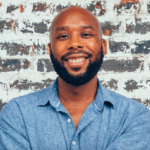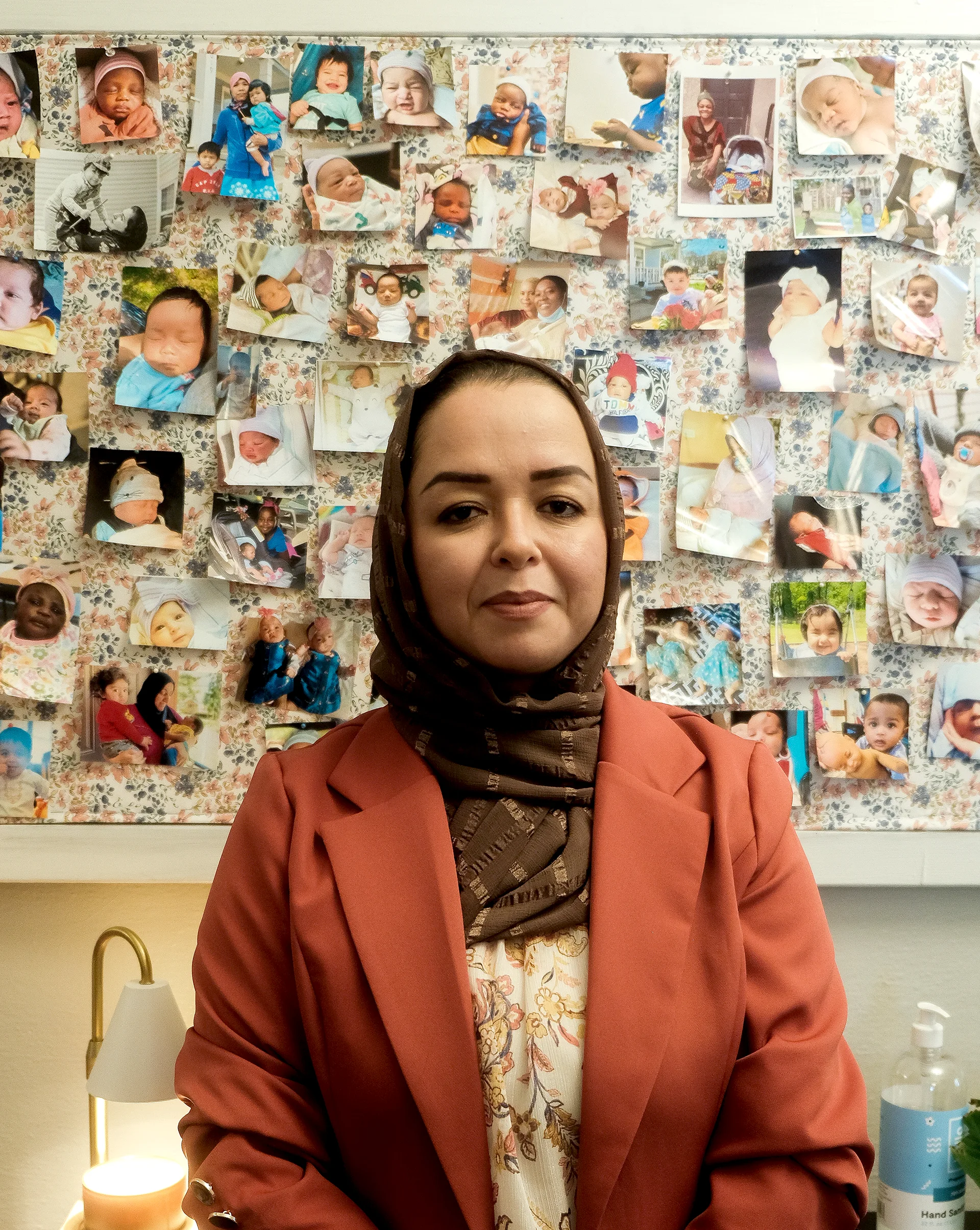

Affordable housing, infrastructure, and education were top of mind when the two remaining candidates for the vacant Atlanta City Council Post 3 at-large seat met at the Center for Civic Innovation Tuesday evening.
Nicole Evans Jones garnered 71,824 votes (40 percent of votes) and Eshé Collins received 43,910 votes (about 24 percent) during the general election last week, both outpacing the other three contenders. Since neither met the 50 percent mark, they’ll face off once again for the runoff on December 3.
Though both candidates, who are Atlanta natives, promote similar platforms, their strategic differences lie in how they draw on their past experiences as educators and local leaders.
CCI founder and director Rohit Malhotra moderated the conversation, which was viewed by about 130 community members in-person and virtually, to offer voters the opportunity to pose questions to get a better understanding of what to expect of Jones and Collins as council members.

“Local elected officials— and specifically city council members— are often a resident’s most proximate experience with government,” Malhotra says. “This offers both a great opportunity to build trust but it is also where trust can be and is most often broken.”
Malhotra began the forum by opening the floor to attendees and asking them, “Where’s your head at? What are you hoping to get out of this conversation tonight? What’s gonna help you make a decision on who you’re gonna vote for?”
“I’m interested to hear about their platforms relative to children and education,” one attendee said. A Grove Park resident added, “I would like to know how the candidates intend to empower neighborhoods and what their track record is thus far.”
In an Election Night survey, conducted by Canopy Atlanta, Atlanta constituents shared that housing affordability and infrastructure improvements were their priorities. At the Tuesday forum, several attendees asked a range of questions on those two subjects. Both Collins and Jones said that if elected, they would be dedicated to policies that would increase housing affordability for city workers and improve Atlanta’s infrastructure as it prepares for major events such as the upcoming 2026 World Cup.
When asked by Malhotra what both candidates would “champion,” Collins and Jones revealed some distinctions in their top priorities.
Jones replied: “I would be a champion for equitable transportation…we need well-maintained roads, we also need protected bike lanes, we need our transit, MARTA, not to cancel 80 percent of its service…If elected I would love to be on the transportation committee.”
Collins replied: “Affordable living for all and ensuring that we have provided a space of true affordability that supports our young families that are in the city, all the way to our legacy residents.”
While Collins and Jones share similar policy positions, they also attempted to distinguish themselves based on their past experience in leadership and organizational roles.
Jones, a longtime Atlanta Public Schools educator, says she sees the connection between poor housing options and student performance. As Thomasville Heights Elementary’s principal, she placed Atlanta Volunteer Lawyer Foundation (AVLF) at her school’s front office to assist families with legal housing disputes.
Collins, a civil rights attorney, has 20 years of experience as an education advocate and educator. While previously serving as the chair of the Atlanta Board of Education, she said the school system saw its “highest graduation to date” and collaborated with city leaders to provide $5 million in funding for Atlanta’s first early education initiative.
“America just elected a president that, statistically, the majority of Atlanta did not vote for,” Malhotra told Canopy Atlanta after the forum. “So we aren’t just electing someone on city council to build progress locally, we are also electing someone who will have the courage, knowledge, and ability to prevent harm and regression— whether that comes from the White House or our own city hall. “
Both candidates defended raising the salaries of city council members to ensure that it would be their sole occupation, increasing their efficiency and ability to engage with the community.
Jones: “When I do hear something, it is ‘I haven’t seen them, I don’t know where they are, I haven’t seen them since they ran.’ And then they will talk about the person who had the seat before them (current council member)…so I do believe that touchpoint is important.”
Collins: “Engagement is key. And it’s not just a term phrase, it’s truly about developing a solid engagement strategy. If you want something in place, there are policies, we could put a process in place in terms of our engagement…It’s the synergy of it all, so that’s the frustration that I think communities are feeling…”
In the wake of what some may consider a vitriolic national election, the candidates in this local race shared their like-minded commitment to constituents, and cordially discussed the intricacies of improving the lives of everyday citizens.
“America just elected a president that, statistically, the majority of Atlanta did not vote for,” Malhotra told Canopy Atlanta after the forum. “So we aren’t just electing someone on city council to build progress locally, we are also electing someone who will have the courage, knowledge, and ability to prevent harm and regression— whether that comes from the White House or our own city hall.”
The runoff election for Atlanta City Council’s Post 3 at-large seat will be held December 3rd. For a full list of voting locations and times, please visit voteatl.org.
For more on both candidates’ platforms and backgrounds, check out their responses to our #VoteATL candidate questionnaire here.
Still undecided? A follow-up forum on transit and urbanism will be held on November 21st. For event details, visit here.
Editor: Stephanie Toone
Canopy Atlanta Reader: Mariann Martin
I hope this story leaves you inspired by the power of community-focused journalism. Here at Canopy Atlanta, we're driven by a unique mission: to uncover and amplify the voices and stories that often go unheard in traditional newsrooms.
Our nonprofit model allows us to prioritize meaningful journalism that truly serves the needs of our community. We're dedicated to providing you with insightful, thought-provoking stories that shed light on the issues and stories that matter most to neighborhoods across Atlanta.
By supporting our newsroom, you're not just supporting journalism – you're investing in Atlanta. Small and large donations enable us to continue our vital work of uncovering stories in underrepresented communities, stories that deserve to be told and heard.
From Bankhead to South DeKalb to Norcross, I believe in the power of our journalism and the impact it can have on our city.
If you can, please consider supporting us with a small gift today. Your support is vital to continuing our mission.
Floyd Hall, co-founder