Earlier this year, Grace Donnelly and I reported a story about the implementation of the Flint River Gateway Trails project set to be constructed in the Tri-Cities. These trails aim to provide more connectivity to the region while highlighting the Flint River and its importance to the Tri-Cities and Georgia as a whole.
During my time reporting, I had the privilege to talk to several community members about their thoughts, opinions and concerns on the potential new development. From these conversations, I learned more than just how these residents felt about the changes to their greenspaces; I got to learn the many ways in which Tri-Cities’ residents have found themselves caught in the winds of change over the past few decades.
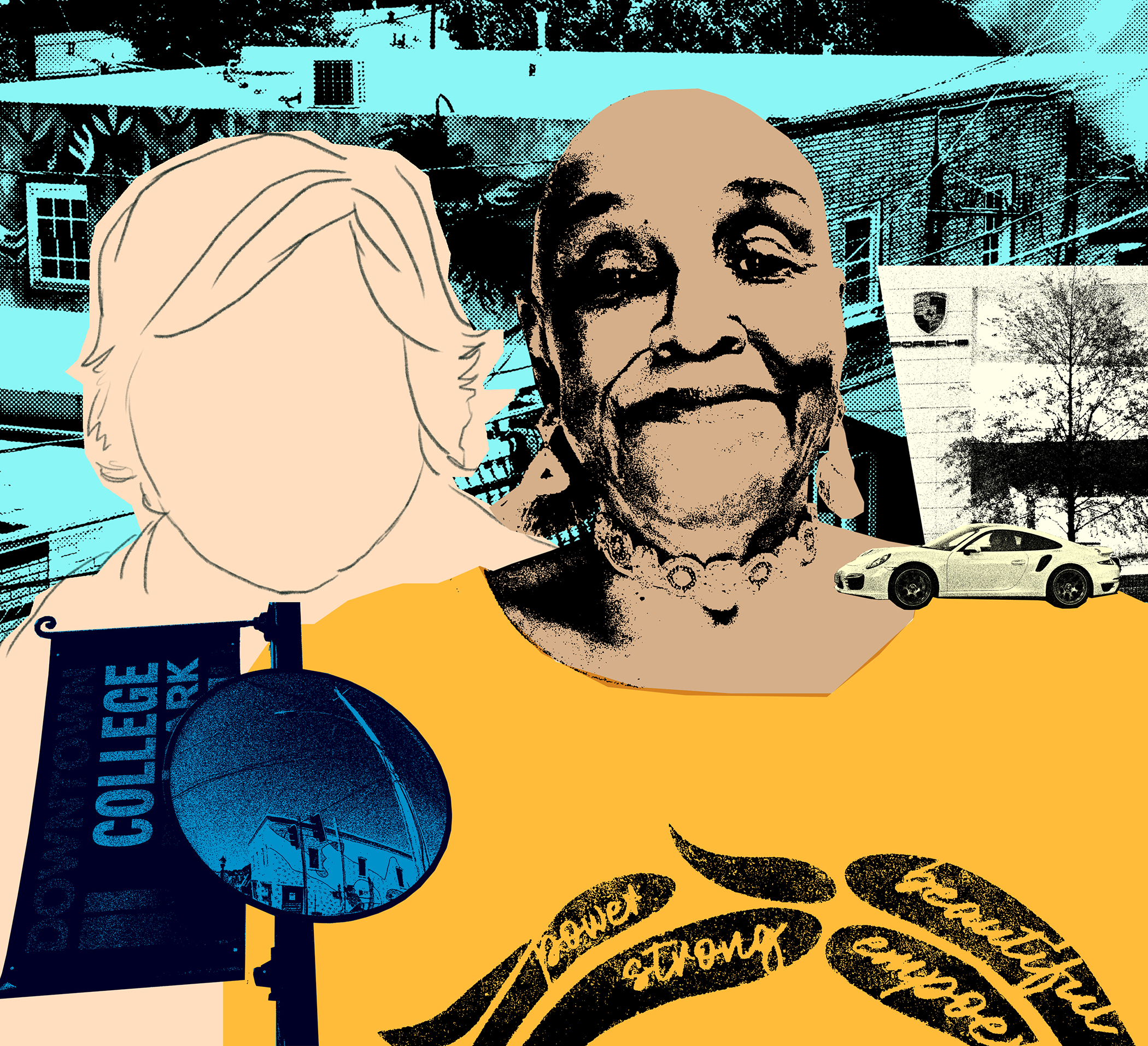
As more newcomers—and new developments—move to the area, developers, city government and the media describe this rapid urbanization as “revitalization,” even though longtime community members risk being left behind. The increasing presence of corporate heavyweights like Chick-fil-A and Porsche loom over the mom-and-pop shops characteristic of the area. College Park’s current mayor and city council are also in constant proxy battles over financial decisions approved by the latter, including a battery storage facility that has residents concerned over industrial pollution.

As a result, some residents are conflicted on the direction of what’s happening to the cities they know and love. Here, three community members share their insights and observations about their home and where they might fit in its future.
Cornelia Dunnings
Cornelia Dunnings, a long-term resident of almost 20 years, reminisces on settling at Headland Terrace in East Point after Hurricane Katrina damaged her New Orleans home in 2005. After previous Ward A councilman Lance C. Robertson used to stop by Dunning’s house to personally hand her “Yard of the Month” awards, Dunnings wishes her new neighbors would take the time to extend the same level of care.
Canopy Atlanta: How did you choose East Point?
Cornelia Dunnings: I didn’t. It chose me. We had been looking for houses all around. We started in unincorporated Atlanta . . . and then me and my daughter-in-law came around here. I said, “Oh I like this house”. . . The house we lost in New Orleans had a crepe myrtle in the front. This house has five crepe myrtles, so it was like God sent us to this specific house. It sat up on a hill, and our house in New Orleans used to flood whenever there was a two-hour rain. It just seemed perfect.
CA: Have you been able to find a similar community here?
Cornelia Dunnings: Not really. I don’t know if you’re from Atlanta, but the people in Atlanta are not very friendly. I don’t know most of my neighbors. They might wave at me and sometimes they’ll pass and tell me they like my decorations ‘cause I decorate for every season.
One across the street—a little old lady who’s been here since East Point started, Mrs. Carver—was the first person who came over the day we moved in. She brought us some homemade pecan pie, it was still hot. When my husband got sick, she would come into his room and talk with him. When he died, she went to the funeral home with us to view the body and make arrangements.
CA: Do you feel like the community isn’t close-knit then?
Cornelia Dunnings: It’s not . . . Most of the people that were living here when we moved here have died, and the new people have moved in. They speak to me when they see me outside and they’re walking their dogs, but nobody stops to have a conversation.
CA: Anything else on your mind?
Cornelia Dunnings: I have a new council person, and I liked my old council person, but I guess I was the only person who liked him in my district, because he didn’t get re-elected. So I don’t really know my new council person.
CA: Why don’t you like this new one?
Cornelia Dunnings: I don’t know. I got to know the old one. He was a nice person, and I won “Yard of the Month” twice, and that’s how I got to meet him, I think it was last year.
CA: Do you feel like it’s easy to know your elected officials in the area?
Cornelia Dunnings: I guess if you attend the city council meetings and things, it’s easy. I was active in New Orleans. But since I’ve been here, I haven’t been active. I go and vote, and I consider that the most active I’ve been.
I guess if I wasn’t so old, I would’ve gotten involved here, but I just don’t find the people here friendly enough to get involved, so I don’t.
Joan S.
Joan S. has lived in the area for 25 years. Through her work and experience living in East Point and Hapeville, she thinks that the Tri-Cities could “be much more vibrant communities than they are,” if it wasn’t for the area’s elected officials.
In August, College Park city council closed off at least one of its meetings to the public and censured the mayor. More than a decade prior, Joan worked with her neighbors to bring several ethics violation charges against then-mayor Earnestine Pittman.
``There are a lot of legacy residents in Hapeville. That’s been changing more since Covid. There’ve been more retirees moving away because they don't like that the city is getting younger and more diverse.``
Canopy Atlanta: Do you think there’s a difference between East Point and Hapeville?
Joan S.: There are a lot of legacy residents in Hapeville. That’s been changing more since Covid. There’ve been more retirees moving away because they don’t like that the city is getting younger and more diverse. But it is a small city. Even though the two and a half square miles of Hapeville has a diverse population with diverse needs, it seems like the mayor and the council are of the mindset [that] all ships rise with the tide.
CA: Is there anything else you would want to share?
Joan S.: Our leadership doesn’t always know how to do things. They’re trying to right some wrongs of the past, but you can’t right the wrongs of discrimination with more inequality and discrimination.
It’s been a repeat pattern of an older generation of leadership that sees things as “us versus them” when you’re talking about race and economics. And so they always stir up, maybe the less educated and more economically challenged people to come get behind them. It’s like the low-hanging fruit: Let me help these people, so that I have these constituents supporting me, because I don’t know how to get these other constituents to support me.
The Trump presidency, I was very triggered and traumatized. I’m a white person . . . but I lived through that kind of hateful division . . . through a mayorship in East Point. Now poor College Park is living through that. It is traumatizing when you know what’s right and what’s not right, and you are very powerless to whoever is in charge. They’re creating division between the residents because some people just believe these lies they’re told. And it takes a long time to clean that up.
Kyle Stanton
As a historian at the Hapeville Depot Museum, who recently worked on the exhibition “Civil Rights and Workers Rights: An exhibition of Hapeville’s Atlanta Assembly Plant,” Kyle Stanton is struck by how changing infrastructure and development in the Tri-Cities reflect a shift in priorities that sometimes overlooks community needs.
``The public transportation system of 100 years ago seems better than what we have now.``
Canopy Atlanta: In what ways do you think the infrastructure could be improved?
Kyle Stanton: I wish MARTA [Metropolitan Atlanta Rapid Transit Authority] ran a little bit later. A light rail would be a dream . . . like a robust public transportation system that only improves the lives of residents. Much more investment in that—it pays off in the end.
Kyle Stanton: The public transportation system of 100 years ago seems better than what we have now. There was a “Dummy Train.” There was a streetcar that was reliable. It just seems like there was a focus on creating this big airport to be an economic hub for the area. Which, it is. But the people who work at that airport still have to get there and have reliable transportation access.
CA: In our community listening, people mentioned the width of the roads, thinking that they’re far too tiny for all the people living there.
Kyle Stanton: That’s something to consider with more and more of these luxury apartments going up over the Tri-Cities. Can the infrastructure handle it? I don’t know if there were meetings before they built these apartments . . . That’s a problem in a lot of places, not just the Tri-Cities: building more and more apartments and not making updates to the infrastructure.
I think about how much Hapeville changed. There used to be a massive assembly plant with blue-collar workers. Across the street, there was a rough bar and a union hall. Now it’s a luxury apartment building and the Porsche Experience. I just think, Wow, that’s such a change in 20 years.
Editor: Christina Lee
Fact Checker: Marlowe Starling
Canopy Atlanta Reader: Mariann Martin
I hope this story leaves you inspired by the power of community-focused journalism. Here at Canopy Atlanta, we're driven by a unique mission: to uncover and amplify the voices and stories that often go unheard in traditional newsrooms.
Our nonprofit model allows us to prioritize meaningful journalism that truly serves the needs of our community. We're dedicated to providing you with insightful, thought-provoking stories that shed light on the issues and stories that matter most to neighborhoods across Atlanta.
By supporting our newsroom, you're not just supporting journalism – you're investing in Atlanta. Small and large donations enable us to continue our vital work of uncovering stories in underrepresented communities, stories that deserve to be told and heard.
From Bankhead to South DeKalb to Norcross, I believe in the power of our journalism and the impact it can have on our city.
If you can, please consider supporting us with a small gift today. Your support is vital to continuing our mission.
Floyd Hall, co-founder