Canopy Atlanta has conversations with community members across metro Atlanta, asking them about the information they need in their communities. A recurring thread from all the communities is the lack of food access in many neighborhoods. This story highlights some of the organizations tackling that challenge.
Canopy Atlanta also trains and pays community members, our Fellows, to learn reporting skills to better serve their community. Jack Rose, the reporter on this story, and Claudia Maturell, the photographer, are both Canopy Atlanta Fellows.

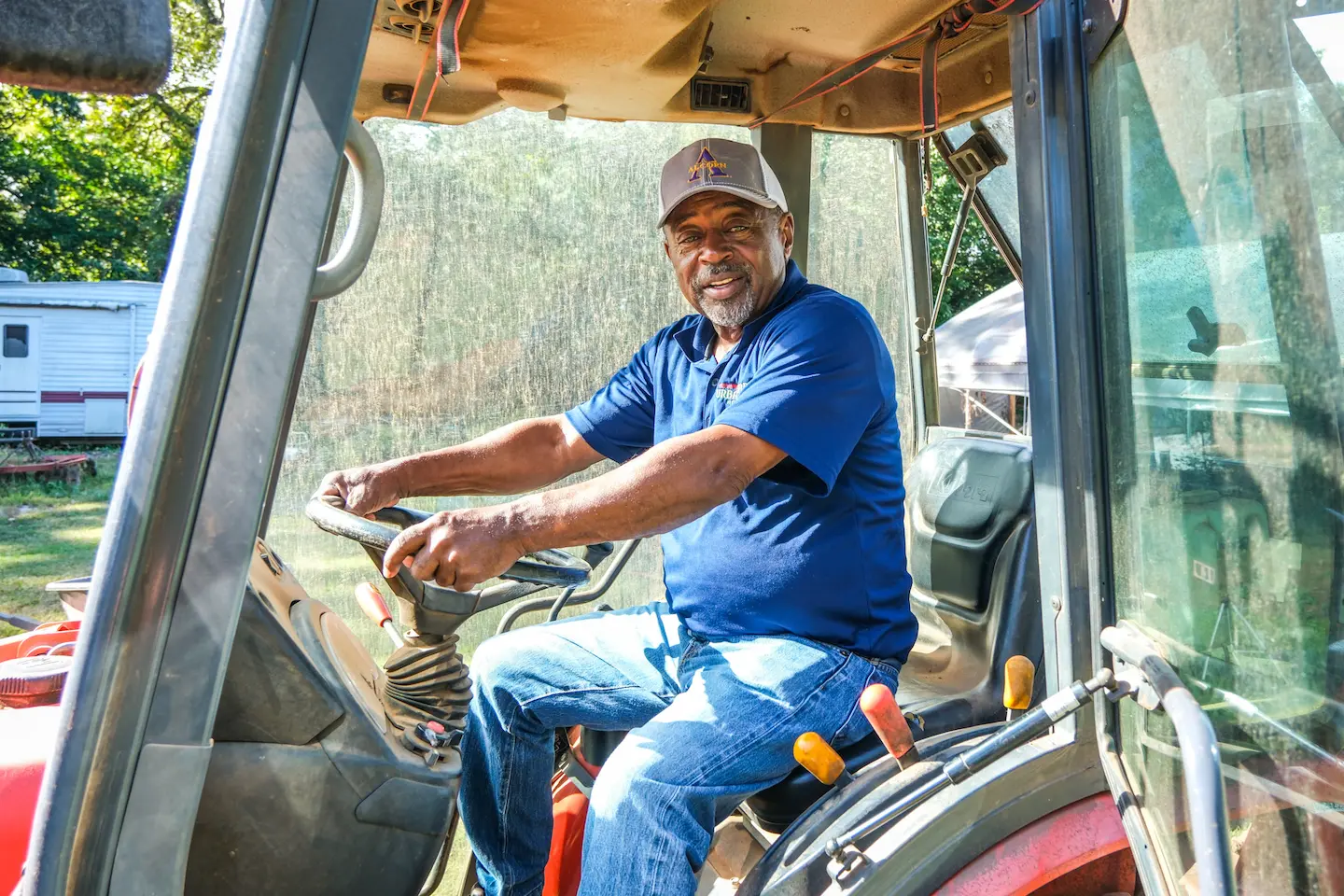
Bobby Wilson’s smile is friendly, his handshake firm, and his property a green patch of productive life within the food desert that is College Park. From chickens cackling in their coops to the bees buzzing by, Metro Atlanta Urban Farm (MAUF) is an almost idyllic example of urban agriculture at a scale rarely seen within the Perimeter.
And in the same way a flower attracts bees, MAUF seems to have a remarkable capacity for drawing in College Park residents looking for both fresh food and education, as evidenced by the young man who walked up the drive to ask Wilson if they were giving out food that day.

“I see Metro Atlanta Urban Farm as an educational facility to train people and to teach them the importance of being able to feed yourself,” Wilson drawls, leaning back in his chair across from me. “This young guy, this is not his first time coming here; I’ve seen him before. The two people I saw this morning that I provided with food—I’ve never seen them before.”
Though a combination of MAUF’s five acres and collaborations with local food banks fed 25,000 during the COVID pandemic, Wilson insists that MAUF isn’t just a food producer, but an education provider.
“There’s two parts to what we do here,” Wilson says, ticking off his fingers. “One is production agriculture, and one is community gardening. Production agriculture is to show farmers how they can make a decent living growing food and securing contracts and being able to feed their community. Two is teaching people how to grow their own fresh fruits and vegetables on small tracts of land in community gardens. Neither part is easy.”


Whether it’s speaking events and plant giveaways at churches, private school field trips, or the Mandela Washington Fellowship for Young African Leaders—a project to teach young African farmers how to adopt MAUF’s practices around clean air, clean water, and clean soil—every aspect of the farm seeks to empower leadership and knowledge in others, so they can lead their own communities towards better agriculture.
“We make our own wine; we call it ‘wine shine.’ We make our own jellies and jams, we pickle our own vegetables so that when the season is over with, we’ll still have some beans to eat and some more greens to eat,” Wilson says.
“We do have a license to make our own wine. We’re not really selling; we’re doing more teaching than we are trying to make a living off of what we process. But the whole idea is to show farmers what they can do or show an individual what he or she can do with the produce that they grow.”
“If I can walk outta my back door and harvest a meal, then that’s gonna tide me over until that truck comes across country again with more food.”
Self-reliance is the core of MAUF’s philosophy, whether that’s nurturing a patch of tomatoes or okra in your backyard or securing a farm number to access U.S. Department of Agriculture (USDA) programs. Though none of MAUF’s food goes to waste, Wilson believes that effectively combating food deserts ultimately lies with Atlanta residents themselves.
“We’re definitely in a food desert here in College Park,” he says. “There’s a Fresh Market grocery store about a mile from here. There’s not a grocery store on this side of us,” he says, hooking a thumb over his shoulder and gesturing west.
“For me, the issue is to teach folks self-reliance on how they can grow some of their own fresh fruits and vegetables. Because when we think about the pandemic, we think about how the food shelves in our major grocery stores were empty at certain times. But if I can walk outta my back door and harvest a meal, then that’s gonna tide me over until that truck comes across country again with more food.”


In a perfect world, however, Wilson still sees major grocery store chains around and thriving, but supplied through local farm co-ops. “A co-op is just a group of farmers coming together to meet the needs of the buyer so that we can supply him or her with what they need,” he says.
“We tried to get the [Atlanta Community Food Bank] to give us a contract to grow collard greens. We had three farmers who were going to be able to meet the need. The only thing that got us off track was the price difference in terms of what we were going to be paid from the food bank.”
Although MAUF is a major resource for College Park and has no problem giving away food and knowledge, it still needs cash flow. Grants from the USDA and assistance from Food Well Alliance, a provider of resources and support for Atlanta growers, go a long way. Wilson is also not the only one who envisions a future where Atlantans can rely on local growers rather than industrial farms states away.
Enter: Kashi Sehgal, founder and CEO of Retaaza. While not affiliated with MAUF, Retaaza represents a business-forward approach to connecting people with hyper-local farmers. It is located in Atlanta and works across the state.
“We get dollars to farmers,” Sehgal says. “We get fresh, healthy, affordable food to our neighbors who are hungry. And we get information and education to everybody else.”
“Anytime you can introduce not just equity but respect, dignity into how you’re helping people and how you are showing up for them, that matters.”
But while Sehgal says that local food has never been more popular, she still admits to an uphill battle when dealing with established players like major grocery chains. “Unless you can hit the same dollar spend that they would be spending with these giant providers, at the end of the day, most decisions come down to dollars and cents.”
Huge growing operations funded by food monopolies benefit from economies of scale to the point where they can outprice local growers looking to secure deals with grocery chains. So while MAUF and other growers like it may have top-quality, organic produce, alternative ways of getting their product to Atlantans, like Retaaza, may be more feasible.


“Anytime you can introduce dignity into the process, not just equity but respect, dignity into how you’re helping people and how you are showing up for them, that matters…It’s okay to make money, but you should not do it at the expense of driving businesses out of the ground,” Sehgal said.
And when it comes to driving that change, whether it’s encouraging government at any level to invest in local agriculture or getting private business to purchase from organizations like MAUF, Sehgal is adamant that it comes down to how people buy locally. Neither Sehgal nor Wilson seem to believe that the solution is a larger budget for handouts, but rather developing infrastructure in the long-term to affect more sustainable business models around local agriculture.
“I think the only way we’re going to solve that is by us growing some of our own fresh fruits and vegetables,” Wilson says. “We got to get back to the basics.”
Editor: Mariann Martin
Copy Editor & Fact Checker: Ada Wood
Canopy Atlanta Reader: Genia Billingsley
I hope this story leaves you inspired by the power of community-focused journalism. Here at Canopy Atlanta, we're driven by a unique mission: to uncover and amplify the voices and stories that often go unheard in traditional newsrooms.
Our nonprofit model allows us to prioritize meaningful journalism that truly serves the needs of our community. We're dedicated to providing you with insightful, thought-provoking stories that shed light on the issues and stories that matter most to neighborhoods across Atlanta.
By supporting our newsroom, you're not just supporting journalism – you're investing in Atlanta. Small and large donations enable us to continue our vital work of uncovering stories in underrepresented communities, stories that deserve to be told and heard.
From Bankhead to South DeKalb to Norcross, I believe in the power of our journalism and the impact it can have on our city.
If you can, please consider supporting us with a small gift today. Your support is vital to continuing our mission.
Floyd Hall, co-founder