The Neighborhood Eats is a series by Faith Mbadugha exploring how restaurants and their development shape a neighborhood’s identity.
Canopy Atlanta trains and pays community members, our Fellows, to learn reporting skills to better serve their community. Faith, the series’ reporter, is a Canopy Atlanta Fellow. This is the first article in the series.

For decades, residents living and working around Cascade—the cluster of southwest Atlanta neighborhoods bisected by Cascade Road, surrounded by Interstates 20 and 285—have recognized how food can create culture and community. What that looks like in 2026, though, appears to be in flux, with how homebuyers and restaurateurs have flocked there. Tri-Cities Fellow Faith Mbadugha spoke with four community members with a keen understanding of how restaurants have shaped the area’s past and present, and what could be in store for the future.

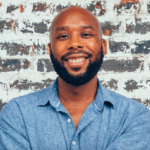
Harold Michael Harvey
In 1990, Harold Michael Harvey was determined to have his 6-year-old son attend Peyton Forest Elementary School, with its “very fine reputation.” Today Harvey says that his neighborhood’s restaurants are just as noteworthy. If only other legacy residents, like him, knew that they were there.
It has always been an effort on the part of people in Cascade Heights to bring more amenities to the community. That was one of the things that was high on the community’s mind when I moved into the community in 1990.
It’s refreshing to see the development of the restaurants now that’s down at the Cascade and Benjamin E. Mays Corridor of Cascade Heights. I think those restaurants are gonna contribute greatly to the sustainability of this community.
Back in the day, in the ’90s and the early 2000s, our destination was Cumberland Mall. We didn’t have Camp Creek up here at that point in time, so we would go to Cumberland because that’s where the nicer restaurants were, or we would go to Lenox on the weekends. The reason that happens is because the businesses are not here. I think that my neighbors have grown accustomed to that over the decades. And so they haven’t necessarily found the new businesses that are beginning to sprout—the type of businesses that we really want to come into the community.
I think the word is not out there that Cascade Heights is now developing upscale businesses and restaurants, like ice cream shops that you can find in other communities and that we’ve always wanted out here. Partly it’s the focus of the city and economic development not being laser-focused on helping small minority businesses operate and to thrive. Then there is not the awareness, I believe, of the public to know that these businesses have actually come into the community, and/or offering the type of services that we’ve always asked for in our community.
Henry Culler
Henry Culler, general manager of The Beautiful Restaurant, remembers a time when the Cascade Road landmark seemingly stood alone on its block: “A lot of this stuff wasn’t here.” Today, he wonders what place The Beautiful Restaurant has in a post-Covid dining scene and a changing corridor.
So I’ve actually been working almost close to 30 years, on and off. I grew up around here, like in the restaurant. This is owned by our church. So I’ve been around this business my whole life . . . I was working here in high school.
Beautiful is just one of the big local hangout spots for people. It’s like a roundtable forum. This here would just be filled with guys just hanging out all day long, going in and out, working and coming back, just hanging out. We used to be open 24 hours. We used to serve breakfast seven days a week. Now we are closed, actually, on Mondays.
Honestly, to be able to sustain this long, I mean, it’s something, especially here in this community and watch the change happen—the evolution of everything. A lot of this stuff wasn’t like this.
Everybody shares the same struggles. We’re not in competition. But it is a challenge, the fight for business or new business or stuff like that. I think establishing a culture, which we have, and having consistency is the main key—and then along with creating some new ideas and being able to adapt to the new.
We have customers who’ve been coming in for years. A lot of them people, they’ve passed ‘cause they were older. So if that’s the case, then you got this new group of people who don’t really know about the history. That is the challenge for us.
With us, we don’t serve alcohol. We don’t have televisions. So that’s its own challenges, that we aren’t like other places. People come in and stay for watching TV. You know, alcohol keeps people. That’s not something we do.
Mia Woods
For years, Mia Woods eyed a restaurant space in a plaza off Cascade Avenue and Westhaven Drive, even though the space was occupied: “I would always hate on that bakery, like, “That should be my spot!’” In summer 2024, Woods opened Mii Mii Poke in that very spot. Customers might not know what poke is when they walk in, “but they see a Black woman with a business and they wanna support,” she says.
The reason why I chose poke is, and the neighborhood that I’m in, is because there are no healthy options. It’s a food desert over here, in the West End, southwest Atlanta. They literally have a Church’s and a Popeyes right across the street from each other, a Checkers next to that, an American Deli. . . . I don’t know if you’ve heard of Tassili’s. I think Wadada is across the street. But other than that, like, come on. We need more options.
The neighborhood is changing. It’s definitely gentrified. Once I saw how the bike riders changed, I knew the neighborhood was changing. It was no more poor man, dope man riding on the bike. Now it’s cyclists with the gear and the thousand dollar bikes. Once I saw that shift, I knew what was coming. I feel fortunate that I got in right at the right time.
A lot of these houses over here, it was a lot of older people who bought these houses. So as they’re selling them, you’re getting a lot of new, young families moving into the neighborhood. I’ve got quite a few customers that, when the weather’s nice, they ride their bikes over with the kids on the back. I’ve gotten to know some of those folks—so that’s been really nice, feeling like I’m a part of the community.
Shea Embry
The Point at Cascade is home to businesses old (Barlow’s Barbershop) but mostly new (juice bar MoreLyfe Co., ice cream shop Aiskrimu, coffee shop Cafe Bartique), though local regardless. Building out The Point hasn’t been easy, says developer Shea Embry, though she calls it “maybe the most important thing I’ve done in terms of real estate.”
I think there’s gonna be a tremendous buy-in from the community, even more so than we’ve already had. But what’s important in neighborhoods, in communities, is people understanding what a walkable community is. The city under the leadership of Tim Keane recognized that if we require parking—so much parking in today’s world—that we’re not supporting the concept that we need walkable communities.
The best quote that I ever heard was from Dorothy Cameron, who was one of our original tenants; she retired after 38 years with her hair salon. She said, “Shea, when I first moved here, everybody walked up here.”
In 2006, the city did a study of Campbellton and Cascade. One of the things in that study is that they would . . . put a sidewalk connecting the houses in Beecher Hills to the commercial district. We have been after the city. We have email chains back to 2017 where the city keeps promising sidewalks . . . and the latest one, they said that it was gonna be 2029. We’re not talking a very big sidewalk. So what I think is gonna happen over the next five years is that when people can walk from Beecher Hill safely—and not in the road on Beecher Road, that’s not safe—that’s when your commercial district will start to become full. I mean, I’m one of those people. I live four-tenths of a mile off of Beecher from this development., and I don’t walk it because it’s not safe. I think it’s a bright future, but the city needs to support it by making it easier for people to access.
When I bought the buildings, there had been a study done by Georgia Tech along with the Cascade Heights Community Development Corporation. One of the things that they came up with when they worked with the community is they wanted local businesses. We have stuck to that request at The Point at Cascade, to the point of our detriment.
Stay tuned for more of Faith’s reporting on restaurants and the communities they serve.
Editor: Christina Lee
Fact Checker: Joey Goodall
Canopy Atlanta Reader: Genia Billingsley
I hope this story leaves you inspired by the power of community-focused journalism. Here at Canopy Atlanta, we're driven by a unique mission: to uncover and amplify the voices and stories that often go unheard in traditional newsrooms.
Our nonprofit model allows us to prioritize meaningful journalism that truly serves the needs of our community. We're dedicated to providing you with insightful, thought-provoking stories that shed light on the issues and stories that matter most to neighborhoods across Atlanta.
By supporting our newsroom, you're not just supporting journalism – you're investing in Atlanta. Small and large donations enable us to continue our vital work of uncovering stories in underrepresented communities, stories that deserve to be told and heard.
From Bankhead to South DeKalb to Norcross, I believe in the power of our journalism and the impact it can have on our city.
If you can, please consider supporting us with a small gift today. Your support is vital to continuing our mission.
Floyd Hall, co-founder