Canopy Atlanta asked over 180 Clarkston community members about the journalism they needed. This story emerged from that feedback.
Canopy Atlanta also trains and pays community members, our Fellows, to learn reporting skills to better serve their community. Lucia Stanislas, a reporter on this story, is a Canopy Atlanta Fellow.

If Clarkston is the most diverse square mile in the country, what would it be like to have spaces that fully reflect that diversity?
While observing Clarkston’s downtown development authority meetings and participating in community engagement sessions, I saw this need echoed repeatedly. At one meeting, when I raised the idea of community hubs, another participant immediately agreed, emphasizing the importance of such spaces for younger generations.
When I began exploring this question, I noticed that belonging and connection in Clarkston are not intentionally designed, they are improvised. Even though Clarkston has a strong identity and attracts people from all over the world and across the United States, the city lacks places, events, and programming where people connect. Where are our third spaces?

A third space is a place where people can connect, socialize, and simply belong. It feels like a home away from home and a place to work outside the conventional office. I enjoy spending time in coffee shops because I consider them my third space. They give me a sense of belonging while allowing me to share conversations and experiences with people from different backgrounds. I am productive there, but I also find myself more creative, inspired, and open to new ideas.
A few spaces in Clarkston already function as informal third spaces, such as Clarkston Market. Clarkston Market features an outdoor area with tables and chairs, a coworking space, a bike shop, and restaurants. Occasionally, families gather, children play, and events like pop-up markets or movie nights bring people together. Still, the space does not consistently attract the level of activity one might expect. It appears underutilized.
When I think about third spaces, economic development comes to mind. I thought of Jacob Bouie, Clarkston’s economic development coordinator. He is passionate and is always willing to share what he knows; I often see him in Clarkston talking with people, listening, and engaging with the community. I felt he would bring a valuable perspective to my exploration of third spaces in my community.
From Bouie, I learned about the Clarkston 2040 Comprehensive Plan, which was based on how the community wanted to see more public spaces and events that bring people together.
Bouie noted that Refuge Coffee Co. does a strong job of bringing together people from different parts of Georgia. At the same time, broader challenges remain. Many immigrant and refugee-owned businesses also face barriers around resources and understanding how business operates in the United States. Bouie notices that small business marketing and outreach are limited, making it difficult for people to discover local businesses. Those barriers make it harder to design spaces that attract and engage the wider community.
As Bouie put it: “It’s hard to build a community with no foundation of outreach, per se.”
One potential solution lies in partnerships, bridging gaps across communities and strengthening connections among residents.
Bouie shared a small but telling example. In collaboration with the city manager, he helped redesign a corner near City Hall with a simple goal: “I want people to stop.” Today, that space includes benches, and he has observed elderly residents, children, and passersby stopping, sitting, and lingering—small moments that signal the potential of intentional design.
“We already have the identity. We need more internal pieces to be innovative about their developments,” he said.
He also added, pointedly: “I have nowhere to take someone on a date that’s here.”
Refuge Coffee, indeed, stands out as the most visible third space in Clarkston. During my first visit a few years ago, I witnessed something that stayed with me. After getting coffee, I sat inside and overheard a conversation between two young men. They spoke openly about trauma, family struggles, and loss. Eventually, they invited me into the conversation and even offered to buy me a croissant. It was a moment of unexpected connection—one where people felt safe enough to share deeply personal experiences. In another instance, an elderly man approached me for help completing paperwork for his health benefits. Again, the space felt open and safe enough for that kind of interaction to happen.
At Refuge Coffee, conversations emerge naturally. People stay for hours, often working, talking, or simply being present. Yet, the regular visitors I observed did not always reflect the full diversity of Clarkston.
I spoke with Stephanie Solvig, Refuge Coffee’s community engagement and partnership coordinator, to understand how an organization creates a sense of belonging. She emphasized how Refuge curates and programs community events, designed to connect people, better reflect the community, and tell a more complete refugee story. These gatherings also create opportunities for visitors to learn about Clarkston’s diversity.
Solvig describes Refuge Coffee as more than a business: “You have people who come here to co-work. You have people who come here to socialize. And then you have people who just come to get out of their houses because they need somewhere to go. The amount of people I have become friends with just by being here is ridiculous.”
At the same time, one of Refuge Coffee’s ongoing challenges is engaging every sub-community and nation represented in Clarkston. To address this, they rely on partnerships to extend their reach. “One of the challenges of being in the most diverse square mile in America is that you can’t engage every single community,” Solvig acknowledged.
And while the organization has employed people from 18 different countries and hosted thousands of participants through events, measuring impact remains complex: “As a third space, there’s data that you can’t gather in a concrete manner.”
At the time of our conversation, a beautiful exhibit displayed photographs and poems tracing a 10-year timeline of Refuge Coffee. I found myself wondering whether the underserved community has access to this rich information.
The emotional significance of belonging becomes even clearer through voices from within the community. In a Refuge Coffee study shared by founder and CEO Kitti Murray, one participant said, “I survived war. I’m just surviving. I just want to work—in peace.”
Another shared simply: “When I miss my country, I go to Refuge.”
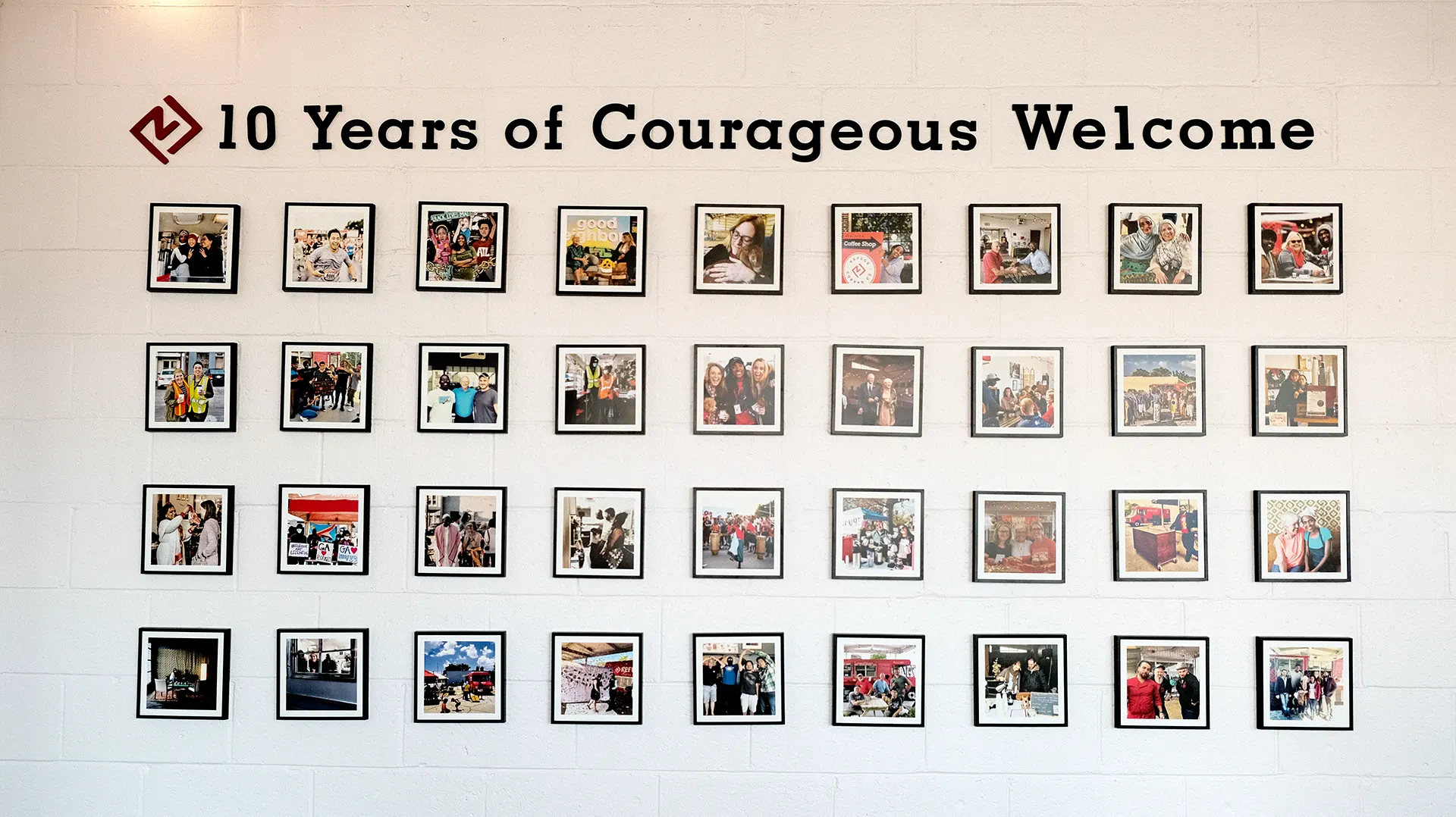
Refuge Coffee Co. Photo by Nushrat Nur.
Both Bouie and Solvig agreed that partnerships are essential to bringing together the many communities represented in Clarkston. No single person or organization can create spaces that foster belonging on their own. This led me to wonder what is an ideal third space—one where people gather, connect, and truly belong. Maybe, I might look beyond Clarkston.
But, first I made one last stop to my co-working space. Edwin Jarvis CoWork Club is one of the suites located beside the open green space at Clarkston Market. Inside, it has high-quality desks and chairs, comfortable couches, and a welcoming coffee area.
I spoke with Barrett Merrill, another member, who shared that he values this space because of his personal connection to the idea of third spaces—places he remembers from his upbringing.
Edwin Jarvis members can work indoors or take their laptops outside. I have even worked barefoot on the grass while watching children play nearby. The space feels warm, relaxed, and family-friendly. However, despite its strong amenities and central location, not many members of the Clarkston community currently use it.
Still seeking community connections, I continued my search for belonging.
Over the next few days, I visited coffee shops, reading rooms, and open community markets in Decatur, Avondale, and surrounding areas. People worked quietly on laptops, families gathered, children played, and bulletin boards advertised local services and cultural events. Some spaces felt intentionally designed for connection; others seemed to grow into it over time.
I drove about seven to 10 minutes from Clarkston and pulled up to a white, ranch-style home—the sign read “Waller’s Coffee Shop.” The first thing that caught my attention wasn’t the coffee, but the space itself. Outside, there was a rustic seating area. Inside, I saw church benches, a colorful bulletin board filled with local announcements, and small details that felt intentional. The barista pointed out a trail behind the building, a play area for children, and other amenities that extended the space beyond a simple transaction.
I spoke with Regis Lawson, a regular customer, “I stay here for three, four, sometimes five hours,” he shared. When I asked if the space reminded him of where he grew up in Paris, he said not exactly, but noted that in Paris, small gathering spaces like this are far more common.
When asked about diversity, he added, “I don’t see too many people from other cultures in coffee shops here.”
What Lawson said shifted my perspective. Initially I saw these spaces as places to gather. Now, I understand these spaces are reflections of who feels included.
In Clarkston, we are diverse. We do our best to meet each other where we are. However, that doesn’t always mean we all feel we belong. Connection is visible in Clarkston. Belonging is more complicated.
Editor: Ann Hill Bond
Fact Checker: J.P. Irie
Canopy Atlanta Reader: TiBerni Hall
I hope this story leaves you inspired by the power of community-focused journalism. Here at Canopy Atlanta, we're driven by a unique mission: to uncover and amplify the voices and stories that often go unheard in traditional newsrooms.
Our nonprofit model allows us to prioritize meaningful journalism that truly serves the needs of our community. We're dedicated to providing you with insightful, thought-provoking stories that shed light on the issues and stories that matter most to neighborhoods across Atlanta.
By supporting our newsroom, you're not just supporting journalism – you're investing in Atlanta. Small and large donations enable us to continue our vital work of uncovering stories in underrepresented communities, stories that deserve to be told and heard.
From Bankhead to South DeKalb to Norcross, I believe in the power of our journalism and the impact it can have on our city.
If you can, please consider supporting us with a small gift today. Your support is vital to continuing our mission.
Floyd Hall, co-founder