This is a weekly feature of our For the Record newsletter, filled with the latest reporting from Canopy Atlanta and Atlanta Documenters, which trains and pays residents to take notes on undercovered local government meetings. Sign up to find this in your inbox every week.

🗣️ QUOTE OF THE WEEK
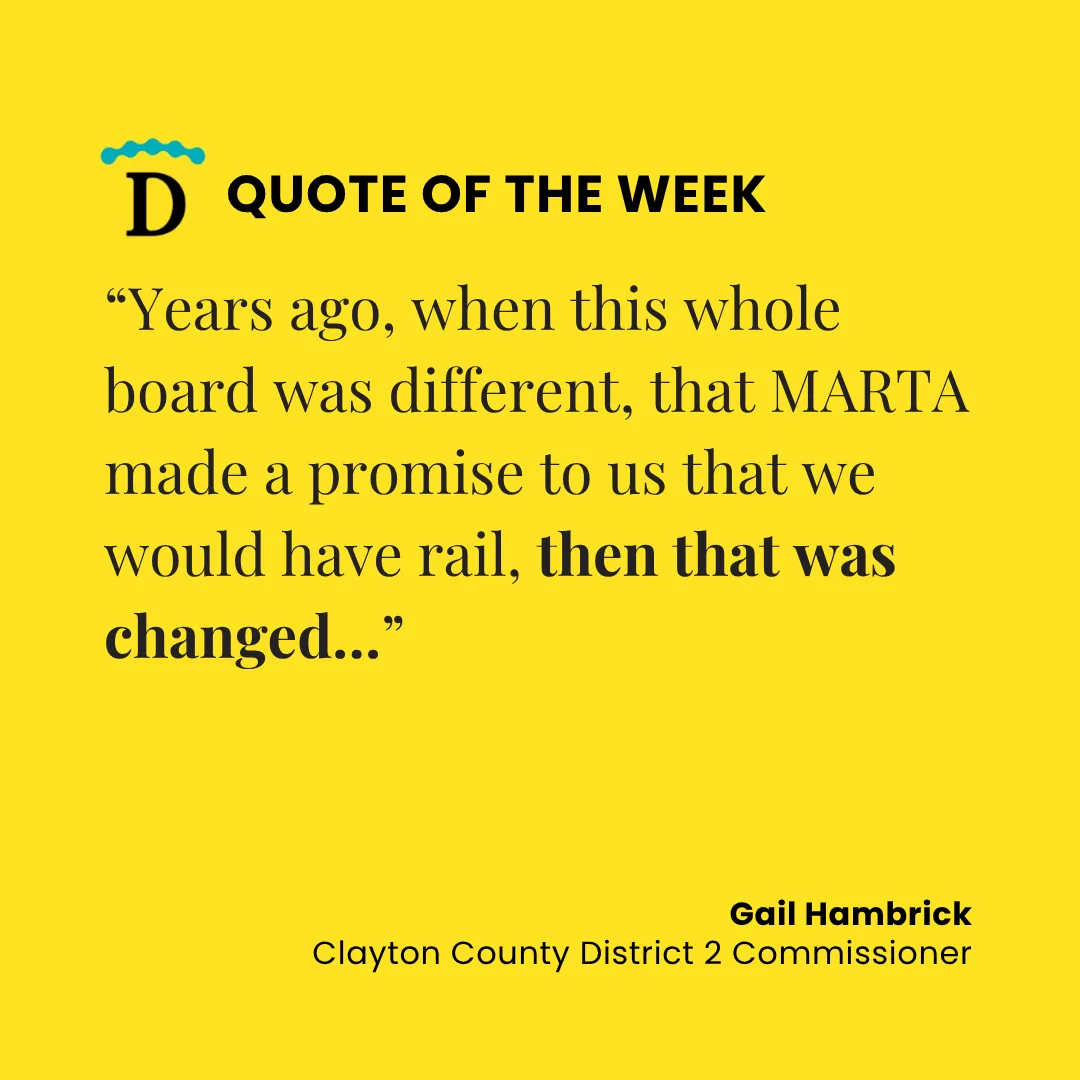
“Years ago, when this whole board was different, that MARTA made a promise to us that we would have rail, then that was changed…”
Following weeks of hesitant votes and fiscal interrogation, both Clayton County and the city of Riverdale approved MARTA’s Southlake Bus Rapid Transit (BRT) line, though neither group gave MARTA a free pass.
Although local leaders faced a fast-coming deadline for $60.9 million in federal funding, they still prioritized strict accountability measures before handing over their endorsements.
The Clayton County Board of Commissioners reversed its July 7 decision to hold the agreement, and approved the BRT line on three new conditions, including that the board would approve major changes like bus route revisions. Less than a week later, Riverdale City Council also approved the agreement, though after inserting a 60-day termination clause and a requirement for MARTA to host town hall meetings with residents.
For some officials, these accountability measures weren’t enough to make up for a decade of frustration. They remember how in 2014, 74 percent of Clayton County voters approved a 1-cent sales tax to join MARTA, largely driven by promises of a commuter rail. As rail plans fell apart, and MARTA pivoted to BRT, hundreds of millions of dollars in local sales tax revenues accumulated in MARTA’s Clayton reserves account.
Gail Hambrick, Clayton County Board of Commissioners vice chair, voted against the Southlake BRT project, in part because she wanted more written commitments from MARTA. “Years ago, when this whole board was different, that MARTA made a promise to us that we would have rail, then that was changed…” she said.
Riverdale Councilmember Wanda Wallace also pressed MARTA Government Affairs Manager Carolina Ramos about the unspent 1-cent sales tax reserves—specifically, asking how much would be on hand for the BRT project. Ramos responded that MARTA only ever agreed to study, versus implement, high-capacity rail in the county.
(Documented by Sirius Darr and Dominique Huff)
🗺️ ZONING CRACKDOWN
Also at the July 21 Clayton County Board of Commissioners meeting, Lovejoy Mayor Marci Fluellyn addressed resident concerns around a proposed data center in Lovejoy, Georgia.
Although unincorporated Clayton County has been under a data center moratorium since September 2025, annexed parcels—property absorbed into city limits from unincorporated county land—aren’t covered. Fluellyn explained that the proposed data center site in Lovejoy was originally annexed, or brought into city limits from unincorporated land, in 2024 for a residential project.
Commissioner Tashé Allen, whose District 3 includes Lovejoy, says she received over 760 concerned emails from constituents.
During public comment, Clayton County resident Attania Jean-Funny alleged deception in the city’s 2024 annexation, calling on the board to de-annex the parcels and urging the city of Lovejoy to regularly publish its meeting minutes.
“Why do we have to go through open record requests to get the minutes from the city of Lovejoy? Why do residents have to do that? Why can’t they just be posted?” Jean-Funny said.
(Documented by Sirius Darr)
💰 BUSINESS AS USUAL?
- Orlando Gooden, Clayton County resident, questioned the county’s $140,000 investment in a July 15 World Cup watch event, which he estimates drew only 50 people. “Even though it was funded by the hotel tax, what was the return on our investment?” (Documented by Sirius Darr)
- Renee Rosser, 37-year Riverdale resident, asked how the city actively promotes council meeting attendance among business owners. “Are the store managers and business owners ever required to be in the meetings, just to hear the concerns of those who patronize their business[es]?” (Documented by Dominique Huff)
- Lamell Cobbs, a Riverdale resident, expressed concerns about the retail she sees on Highway 85, focusing on its tire shops and a 24/7 smoke shop. “Even the people who live in Riverdale don’t shop in Riverdale. And that’s a problem,” Cobbs said. (Documented by Dominique Huff)
🖥️ BRINGING CIVIC INVOLVEMENT ON LINE
Riverdale will launch a refreshed, user-friendly website in August or September, featuring digital customer services, meeting schedules, and an event calendar.
The city is also evaluating low-cost livestreaming solutions for council meetings. After ruling out Facebook Live due to low follower counts, the city will explore YouTube and a potential setup partnership with Clayton County.
(Documented by Dominique Huff)
Editor: Christina Lee
Fact Checker: J.P. Irie
I hope this story leaves you inspired by the power of community-focused journalism. Here at Canopy Atlanta, we're driven by a unique mission: to uncover and amplify the voices and stories that often go unheard in traditional newsrooms.
Our nonprofit model allows us to prioritize meaningful journalism that truly serves the needs of our community. We're dedicated to providing you with insightful, thought-provoking stories that shed light on the issues and stories that matter most to neighborhoods across Atlanta.
By supporting our newsroom, you're not just supporting journalism – you're investing in Atlanta. Small and large donations enable us to continue our vital work of uncovering stories in underrepresented communities, stories that deserve to be told and heard.
From Bankhead to South DeKalb to Norcross, I believe in the power of our journalism and the impact it can have on our city.
If you can, please consider supporting us with a small gift today. Your support is vital to continuing our mission.
Floyd Hall, co-founder