Canopy Atlanta’s 2024 election project kicked off this spring and runs until Election Day. Voting Barriers and Bridges, which will focus on communities with chronically low voter participation, will identify the barriers around civic engagement and uplift solutions that can bridge those barriers.

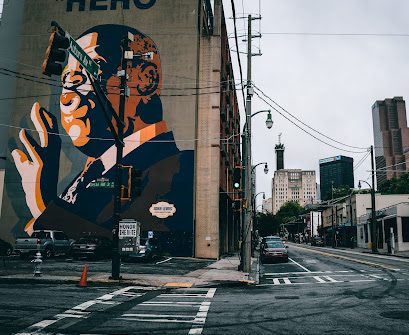
Pictured above is a scenic view of the Sweet Auburn’s John Lewis Mural on Auburn Avenue, which sits within one of the lowest voter precincts in metro Atlanta.
The background
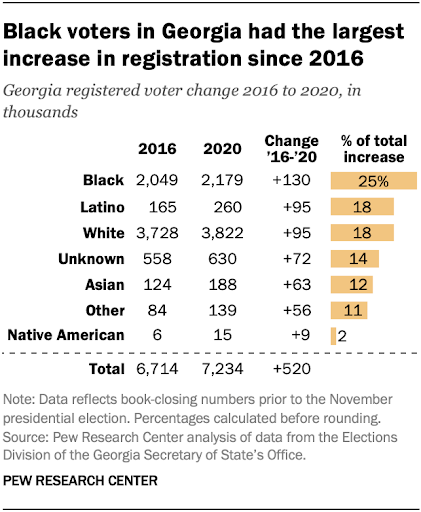
In 2020, Georgia was on everyone’s mind. It turned blue. For the first time after almost three decades—since Bill Clinton—Georgia elected a Democratic president, Joe Biden. Georgia was the only Deep South state that voted blue in national elections in 2020. Such drastic changes were attributed to affluent, college-educated, and older voters in the suburbs around Atlanta, according to New York Times’ Upshot analysis of the results by precinct. The engagement of minority voters in Georgia was groundbreaking, with the number of Black registered voters increasing by about 130,000 between Oct. 11, 2016, and Oct. 5, 2020, according to Pew Research Center.
The turnout for Georgia’s 2022 midterm elections continued that trend. Despite the growth in statewide voter participation, there continues to be a contrasting reality: the persistent lack of voter turnout for Black and brown communities in metro Atlanta. Examining data from Georgia’s official 2020 Statement of Votes Report, our research team found that less than 30% of registered voters in communities such as Union City and College Park cast their ballots in the general election that year, with some precincts voting at less than 15%.
Bridging the barriers
While mainstream media tends to focus on either the historic turnouts or the political apathy of minority voters, our election project will seek to report on these communities without the broad strokes. Rather than filling these gaps with assumptions, Canopy Atlanta wants to unveil truth to power narratives directly from residents: Why will (or won’t) Atlantans vote this November? What explains the low voting turnout for our communities in Atlanta?
Working with local residents through our Barriers and Bridges Election Project, Canopy Atlanta seeks to bring forth unheard voices from communities with chronically low voter turnout. Canopy Atlanta’s election project will explore how civic engagement and voter interest may have changed since the 2020 elections. As we embark on another historic election year amid Georgia’s ever-evolving election laws, it is critical to unravel and address these overlooked barriers to voting.
“Our work at Canopy Atlanta focuses on listening to what communities need and learning how to provide them with tools to create better communities,” said Mariann Martin, co-founder of Canopy Atlanta. “We are excited to take this approach to understand community needs around voting and civic participation: why people may not feel empowered to vote, may find it difficult to vote, or don’t feel like their vote has made a difference in the past.”
Using statewide election data as our foundation, our coverage will examine:
- Barriers affecting the 20 metro Atlanta precincts with the lowest voter turnout
- Participation in recent general elections to determine voting patterns in those communities
- Factors that could contribute to changing civic engagement in Georgia, such as population shifts, candidate quality, understanding of the issues.
Throughout this project, we’ll share community members’ personal stories in the hope that they can become catalysts for change. Our ultimate goal is to bring transparency to the electoral process and accountability to the elected officials charged with carrying out that process.
Listening first
Over the last four years, Canopy Atlanta has surveyed more than 600 people about what matters most to them, on topics like economic development, affordability concerns, and school choice. These listening sessions have been translated into community stories, policy recommendations, and community movements. Through this project, we’ll continue that work by listening to the community first. With community listening as our barometer, we hope to hear what ballot issues and day-to-day concerns will attract voters to the polls—or turn them away.
“There are preconceived notions about what it means when communities of color don’t have high voting numbers,” said Stephanie Toone, community engagement editor at Canopy Atlanta. “I am fully committed to going beyond the numbers and learning about the people. Through conversation and connection, I look forward to helping tell the stories of these metro Atlantans and their relationship with the civic process.”
Listening sessions started in May and will continue through June. Visit our FAQs page for more information.
Strengthening democracy
Our work is guided by what we’ve learned and will learn in our nine-month Advancing Democracy Fellowship, an effort led by journalism collectives Hearken, Trusting News and the Solutions Journalism Network. This fellowship helps news organizations like ours transform their political coverage by shifting away from horse-race narratives focusing on candidates and opinion polls toward stories that prioritize community concerns and how to address them.
“The Advancing Democracy Fellowship supports reporters and editors in strengthening our democracy through innovative news coverage that highlights promising responses to our democracy’s challenges and builds civic engagement, equity, and healthy discourse,” the fellowship website reads. “The idea is to help newsrooms embrace a deep, ongoing examination of issues that will help communities see—and work toward—possibilities for building a better world.”
To learn more about the Voting Bridges and Barriers Election Project, visit https://canopyatlanta.org/elections.
Editor: Stephanie Toone
Fact Checker: Julianna Bragg
Canopy Atlanta Reader: Heather Buckner